CH8: Vulnerability Prioritization and Mitigation
Introduction
Every security operations center receives a constant stream of vulnerability reports. Vulnerability scanners identify thousands of issues across the infrastructure. Patch notifications arrive daily. Third-party risk assessments reveal exposure in supply chain dependencies. In an idealized world, every vulnerability would be remediated immediately. In practice, every organization faces resource constraints: limited patching windows, testing bandwidth, change management overhead, and competing business priorities. The core challenge of vulnerability management is deciding which vulnerabilities to address first and how to fix them effectively, more than identifying them. This chapter examines how mature SOC teams prioritize remediation efforts, apply vulnerability scoring frameworks, and execute mitigation strategies that balance risk reduction with operational reality.
Learning Objectives
Upon completion of this chapter, you will be able to:
- Apply multiple prioritization criteria (exploitability, active exploitation, asset value, and impact) to rank vulnerabilities by organizational risk.
- Evaluate and compare CVSS and EPSS scoring methods to understand their strengths and limitations in real-world triage.
- Analyze context-dependent factors (network isolation, asset criticality, business function) that influence remediation decisions.
- Design mitigation strategies appropriate to vulnerability type, including patching, compensating controls, and attack surface reduction.
- Validate remediation effectiveness and document decisions for compliance and audit purposes.
8.1 Understanding the Prioritization Challenge
The fundamental reality of vulnerability management is scarcity. No organization has unlimited time, budget, or change windows to remediate every finding. A mid-size enterprise might discover 5,000 vulnerabilities in a quarterly scan; a large enterprise might find 50,000 or more. The vulnerability scanning process itself generates noise: some findings are false positives, some affect non-critical systems in isolated network segments, and some cannot be patched without business disruption. The cost of addressing every vulnerability immediately often exceeds the cost of accepting managed risk on lower-impact issues.
Vulnerability prioritization bridges this gap. It establishes a repeatable process for ranking findings by organizational risk and making deliberate decisions about which issues to remediate, which to monitor, and which to accept as part of the risk profile. This process requires input from multiple stakeholders: security teams understand vulnerability severity and exploitability, operations teams know patch testing windows and system dependencies, and business teams understand asset criticality and compliance requirements.
Figure 8.1 combines security, operations, and business inputs in one accountable decision.
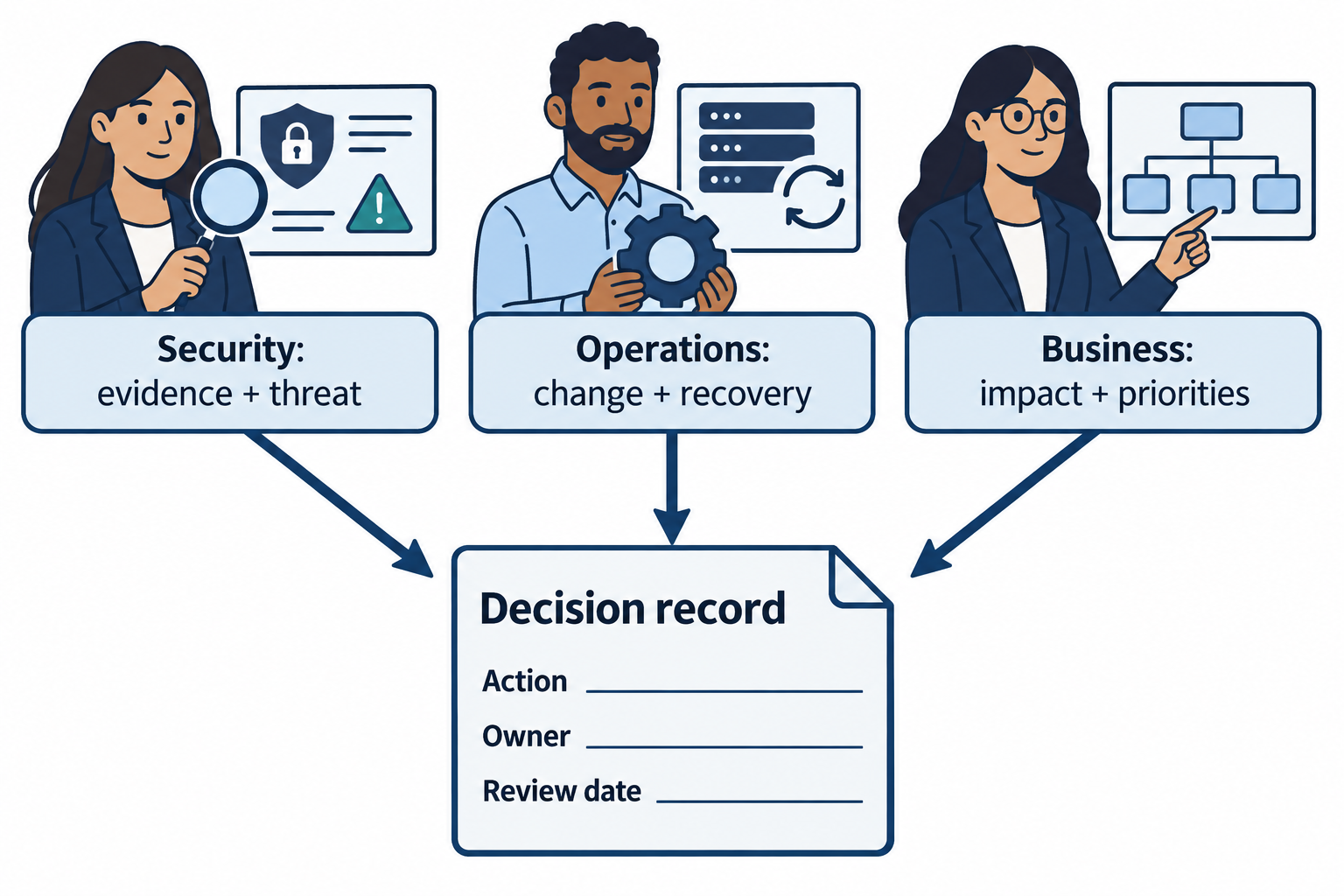
Figure 8.1: A remediation decision combines technical evidence, operational constraints, and business impact. The resulting record names an action, an owner, and a review date.
Text description for Figure 8.1
Security staff evaluate confirmed findings, severity, exploit prerequisites, and observed threats. Operations staff identify dependencies, change options, and recovery needs. Business owners explain service impact and acceptable risk. These inputs support a documented action and accountable owner. Constraints shape how to reduce risk; they do not automatically justify leaving an exposed system unchanged.
The trade-off between coverage and speed is constant. Rapid patching of internet-facing systems may leave internal vulnerabilities unaddressed. Comprehensive testing before patches reduces risk of regression but delays remediation. Waiting for vendor patches on zero-day issues is the correct choice until exploits appear, but once active exploitation is confirmed, the urgency changes dramatically. Organizations must establish clear decision criteria that balance these competing pressures.
False Sense of Completeness
Vulnerability scanning creates the illusion of knowing your risk profile. A clean scan report does not mean your infrastructure is secure, it means that known vulnerabilities have been identified. New vulnerabilities are disclosed daily. Unscanned systems and air-gapped networks may harbor critical exposures. Vulnerability prioritization must account for the limitations of the scanning process itself and recognize that the absence of a finding is not evidence of absence of risk.
8.2 Prioritization Criteria
Effective prioritization requires a structured framework that considers multiple dimensions of risk. No single criterion is sufficient on its own. A vulnerability with high exploitability but only minor impact might be lower priority than a vulnerability with moderate exploitability but critical impact on a revenue-generating system. The following criteria form the foundation of most organizational prioritization processes.
Exploitability
Exploitability refers to the ease with which an attacker can successfully exploit a vulnerability. High exploitability indicates that attacks are feasible with readily available tools and moderate skill; low exploitability means that successful exploitation requires specialized knowledge, specific conditions, or sophisticated tooling.
Key dimensions of exploitability include:
- Public exploit code availability: Vulnerabilities with publicly released proof-of-concept (POC) exploits or metasploit modules are significantly more dangerous than those requiring custom development. Once POC code is published, the barrier to exploitation drops dramatically.
- Exploit complexity: Some vulnerabilities require only a single HTTP request to trigger; others demand a specific sequence of steps, race conditions, or pre-existing access. CVE-2021-26855 (ProxyLogon) could be exploited with a simple HTTP request; it demanded no authentication and created extremely high exploitability.
- Attack requirements: Vulnerabilities requiring network access only are more exploitable than those requiring local system access. Those requiring user interaction (clicking a link, opening an attachment) are less exploitable than those triggered remotely without user action. Authentication requirements reduce exploitability significantly.
- Known active exploitation: The most critical signal is whether a vulnerability is already being exploited in the wild. Once attackers actively weaponize a vulnerability, it moves from theoretical risk to operational threat and demands immediate prioritization.
The CVSS framework encodes exploitability in its metric set, but context matters. A vulnerability rated as "low exploitability" in CVSS might be extremely exploitable within a specific environment where the attack requirements are already met.
Active Exploitation and Threat Intelligence
Active exploitation is the fastest signal that a vulnerability has moved from potential risk to operational threat. Once malware, exploit kits, or threat actors are confirmed to be exploiting a specific vulnerability, remediation urgency becomes critical. Active exploitation can be detected through multiple channels:
- Public threat intelligence: Security researchers, vendors, and threat intelligence services monitor the threat landscape for weaponized exploits. Alerts from trusted sources (US CISA, vendor security teams) that a vulnerability is being actively exploited often serve as the trigger to move a vulnerability to the highest prioritization tier.
- Internal network detection: Your SIEM, IPS, or endpoint detection tools may observe exploitation attempts. Scanning traffic, malware payloads, or unusual network behavior targeting a known vulnerability indicates active threats against your environment.
- Dark web and underground forums: Threat intelligence teams sometimes discover exploit code, tutorials, or discussion of weaponization in underground forums before public disclosure.
The distinction between scanning and exploitation is critical. An attacker conducting reconnaissance port scans is different from an attacker sending exploit payloads. False positives can occur when legitimate scanners or compliance tools trigger alerts designed to detect attack patterns. SOC teams must distinguish between legitimate activity and malicious exploitation.
Analyst Perspective
A common situation: Your SIEM flags 47 alert instances of "possible ProxyLogon exploitation attempt" in a single day. Your first action should be to check if your own compliance scanner or patch management tool is running a test against those systems. Automated false positives can overwhelm prioritization processes. Validate before escalating.
Asset Value and Criticality
Not all systems are equally important to the organization. A vulnerability in a production database server serving customer-facing transactions has vastly different impact than the same vulnerability in a test environment accessed only during development. Asset criticality requires understanding your infrastructure:
- Inventory and classification: Organizations should maintain an asset inventory that categorizes systems by business function. Production systems supporting revenue directly are critical tier; backup systems supporting internal processes are important tier; development and test environments are lower tier.
- Data sensitivity: Systems processing or storing personally identifiable information (PII), payment card data, trade secrets, or regulated information require higher protection standards. A vulnerability in a healthcare data warehouse has higher impact than the same vulnerability in a public-facing marketing website.
- Network position: Systems on the DMZ or internet-facing are more exposed than internal systems behind firewalls. Air-gapped systems in isolated network segments have lower risk of exploitation. Network segmentation acts as a compensating control that reduces the criticality of vulnerabilities.
- Business dependencies: Some systems are single points of failure. If a critical application depends on a specific service, vulnerabilities in that service demand faster remediation. Conversely, redundant systems with failover capabilities can tolerate longer remediation timelines.
An effective asset management process maps vulnerabilities to systems and then evaluates the criticality of those systems. A critical vulnerability affecting only non-critical systems may be lower priority than a moderate vulnerability in a critical system.
Impact Assessment
Impact describes the consequences if a vulnerability is successfully exploited. This extends beyond technical severity to business and operational impact.
The CIA triad (Confidentiality, Integrity, Availability) provides a framework:
- Confidentiality impact: Can the exploit reveal sensitive data? A vulnerability exposing customer databases or internal communications has high confidentiality impact.
- Integrity impact: Can the exploit modify or corrupt data? Attacks modifying financial records or application code have high integrity impact.
- Availability impact: Can the exploit disrupt service? Vulnerabilities enabling denial of service or system shutdown have high availability impact.
Impact scope matters significantly. A vulnerability affecting a single workstation has lower scope than one affecting a shared service used by many users. A vulnerability enabling lateral movement from a compromised system to sensitive infrastructure has cascading impact beyond the initially compromised asset.
The business context determines whether confidentiality, integrity, or availability is most critical. A financial services firm might weight integrity impact heavily (unauthorized transaction modification is catastrophic). A news organization might weight availability impact (service disruption during critical events). A healthcare provider must weight all three.
Figure 8.2 connects confidentiality, integrity, and availability to business consequences.
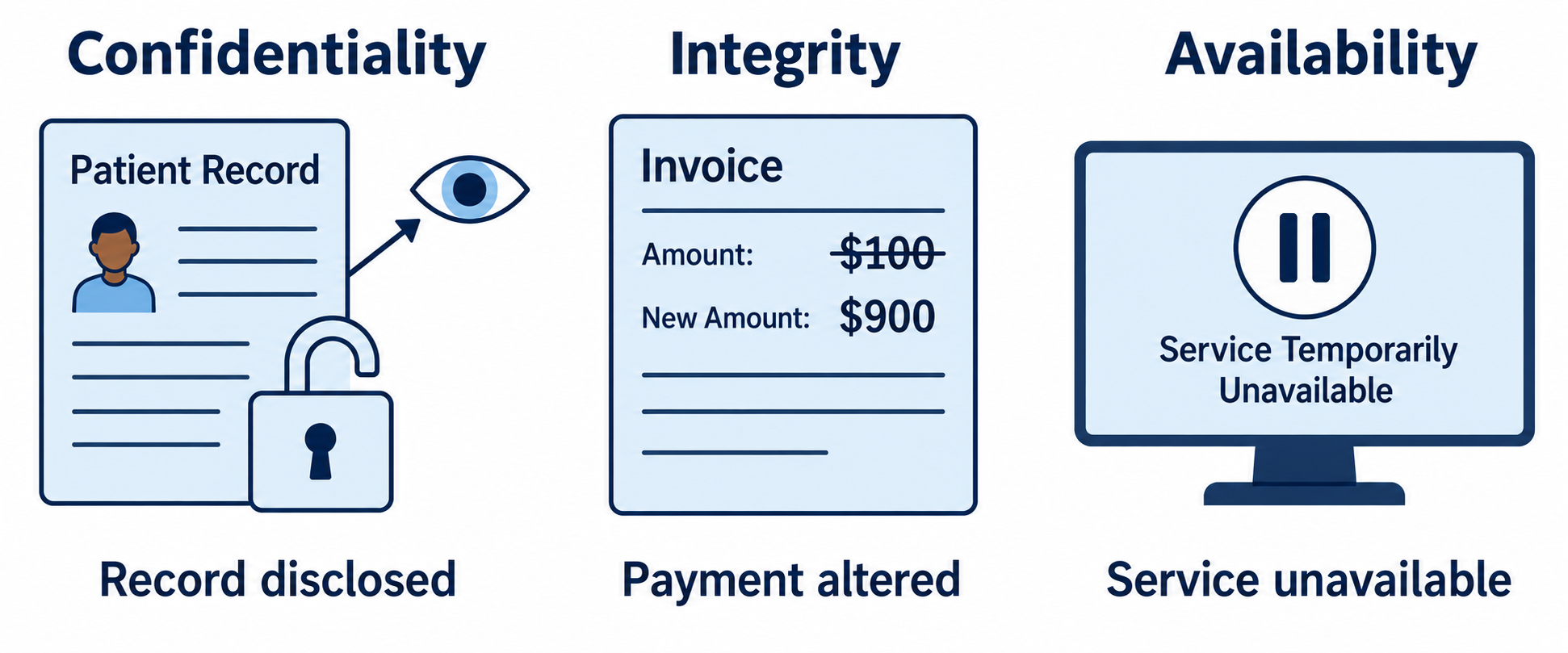
Figure 8.2: Confidentiality, integrity, and availability connect a technical weakness to consequences for people and services.
Text description for Figure 8.2
Confidentiality means restricting access to information: disclosure of customer records can harm the people named in them. Integrity means protecting information from unauthorized changes: an altered payment amount can cause an incorrect transaction. Availability means keeping authorized services usable: an outage can prevent staff from completing work. A single incident can affect more than one of these goals, and dependencies can spread the impact beyond one asset.
Patch Availability and Feasibility
Even the highest-priority vulnerability cannot be remediated if no patch exists or if patching creates unacceptable risk. Vendor responsiveness varies:
- Patches available and tested: When vendors release patches and confirm them through customer feedback, remediation becomes straightforward. The timeline for patching becomes a matter of testing and change management.
- Patches scheduled but not released: Vendors often provide advance notice of upcoming patches. Organizations can plan change windows and testing in advance.
- No patch available (zero-day): When vulnerabilities are disclosed without available patches, compensating controls and monitoring become the primary mitigation strategy. This is temporary; vendors typically release patches within days or weeks. But in the interim, organizations must decide whether to risk accepting the vulnerability or deploying workarounds.
- Legacy systems with no patch path: Some older systems no longer receive vendor support. Organizations must choose between accepting risk, decommissioning the system, or deploying compensating controls. This is often the driver for system modernization initiatives.
Patch feasibility also includes regression risk. Patches sometimes introduce new bugs or break functionality. Testing patches in non-production environments before deploying to production is essential but time-consuming. Systems with tightly coupled dependencies or complex configurations require more extensive testing. Critical systems often cannot be patched during business hours, limiting change windows to maintenance periods.
True Positives, False Positives, and Verification
Vulnerability scanning can produce false positives: vulnerabilities reported by scanners that do not actually exist in the environment. A scanner might identify a service as vulnerable based on its banner version, but the installation might be patched or the service might not actually be in use. Investigating and confirming each finding before investing in remediation is more efficient than blindly remediating every scanner report.
Conversely, false negatives, vulnerabilities that are not detected, create risk. A vulnerability might not be detected because the system was offline during the scan, the scanning tool did not have coverage for that vulnerability, or the vulnerability requires privileged access to discover. Risk acceptance for undetected vulnerabilities is part of the vulnerability management process, but organizations should seek to minimize false negatives by using multiple scanning tools and maintaining high scan coverage.
Figure 8.3 shows how to verify a reported finding and identify scan-coverage gaps.
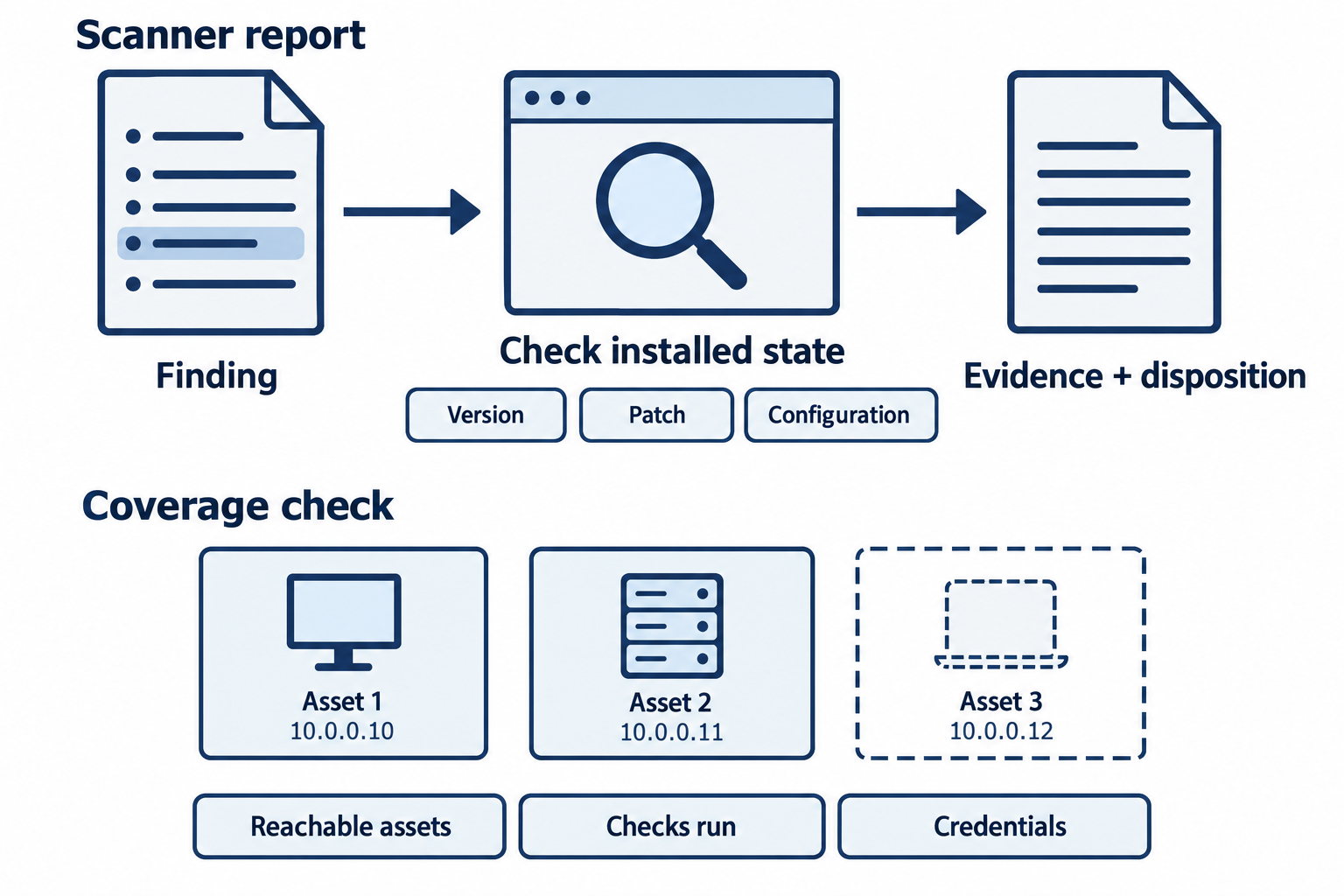
Figure 8.3: A scanner finding needs evidence of an affected component and its actual configuration. A missing finding also needs context about scan reach and coverage.
Text description for Figure 8.3
For a reported finding, confirm the asset, installed component, patch state, configuration, and the scanner test that produced it. A version banner alone can mislead, for example when a vendor backports a fix. Record a confirmed issue, a supported false positive, or an unresolved result. Separately review which assets were reachable, which checks ran, and whether required credentials worked. No finding from an incomplete scan establishes that a system is safe. The asset addresses are illustrative private-network addresses; the dashed asset marks a coverage gap. Reachability, executed checks, and credentials apply to the assessment as a whole.
8.3 Vulnerability Scoring Methods
Vulnerability scoring provides a standardized way to estimate severity and priority. Two dominant frameworks exist: CVSS (Common Vulnerability Scoring System) and EPSS (Exploit Prediction Scoring System). Each has strengths and limitations.
CVSS: Standardized Severity Scoring
The Common Vulnerability Scoring System (CVSS) is a standardized framework for rating vulnerability severity. CVSS v3.1 is the current standard and remains widely adopted. It generates a numerical score (0–10) reflecting vulnerability severity, with categorical ratings (Critical 9.0+, High 7.0–8.9, Medium 4.0–6.9, Low 0.1–3.9).
CVSS v3.1 includes three metric groups:
Base Metrics (always present, context-independent):
- Attack Vector (AV): network, adjacent network, local, or physical (network is most severe)
- Attack Complexity (AC): low or high (low is more exploitable)
- Privileges Required (PR): none, low, or high (none is more exploitable)
- User Interaction (UI): none or required (none is more exploitable)
- Scope (S): unchanged or changed (whether the vulnerability affects resources beyond the vulnerable component)
- Confidentiality Impact (C), Integrity Impact (I), Availability Impact (A): none, low, or high
Temporal Metrics (optional; reflect the current state of exploitation and available patches):
- Exploit Code Maturity (E): unproven, proof-of-concept, functional, or high
- Remediation Level (RL): unavailable, workaround, temporary fix, official fix, or workaround
- Report Confidence (RC): unknown, reasonable, or confirmed
Environmental Metrics (optional; reflect organizational context):
- Security Requirement (SR): low, medium, or high for each of C, I, A (how critical is each type of impact?)
- Modified Base Metrics: allows adjustment of base scores for organizational context
Figure 8.4 organizes the three CVSS v3.1 metric groups.
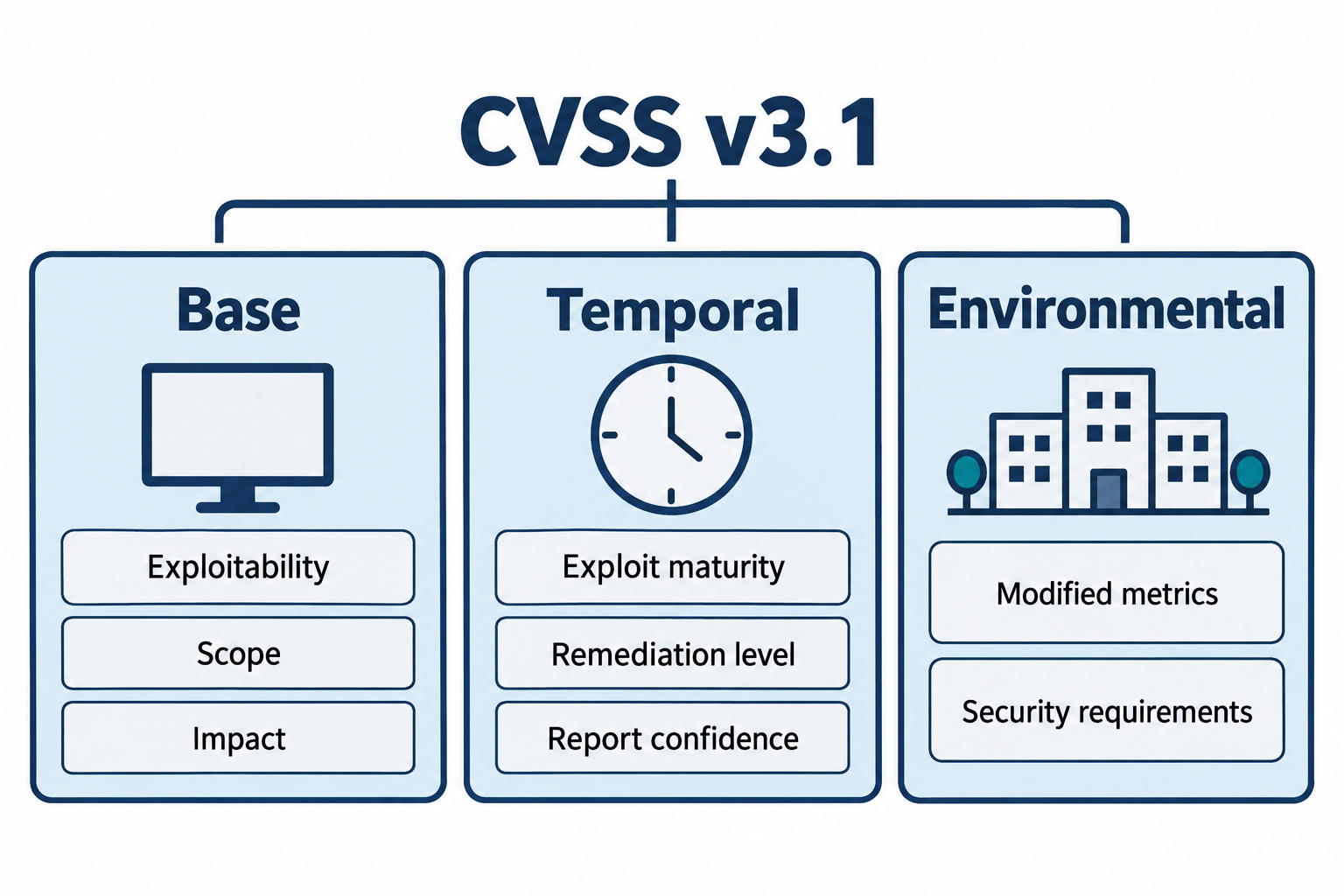
Figure 8.4: The Common Vulnerability Scoring System (CVSS) v3.1 groups metrics into Base, Temporal, and Environmental. This diagram matches the version discussed here; FIRST now maintains CVSS v4.0.
Text description for Figure 8.4
CVSS describes vulnerability severity. In version 3.1, Base metrics describe exploitability, scope, and technical impact. Temporal metrics capture exploit-code maturity, remediation level, and report confidence. Environmental metrics adjust relevant base values and confidentiality, integrity, and availability requirements for a deployment. Report the version and vector with a score so readers can interpret it. These v3.1 groups must not be relabeled as the v4.0 metric model.
Strengths of CVSS:
- Standardization: All vulnerabilities are scored using the same methodology, enabling comparison across vendors and vulnerability databases.
- Reproducibility: Given the same inputs, CVSS always produces the same score.
- Transparency: The metrics are published and stakeholders understand what drives each score.
- Wide adoption: CVSS is the default scoring system used by NVD, vendor advisories, and vulnerability databases.
Limitations of CVSS:
- No business context: CVSS does not account for asset criticality, network isolation, or organizational risk appetite. The same CVSS score for a vulnerability in a critical production system and a test environment receives identical scores.
- Temporal delay: CVSS base scores are static and published at the time of vulnerability disclosure. As threat intelligence develops and exploits become weaponized, CVSS does not automatically adjust. Temporal metrics attempt to address this but are rarely updated.
- False precision: CVSS scores appear objective but embed subjective judgments. Two organizations might reasonably interpret the same vulnerability metrics differently.
- Does not predict exploitation: A high CVSS score does not predict whether a vulnerability will actually be exploited. Many high-scoring vulnerabilities are never weaponized; some low-scoring vulnerabilities become widespread attacks because they are easy to exploit and prevalent.
EPSS: Exploitation Probability Scoring
The Exploit Prediction Scoring System (EPSS) takes a different approach. Instead of scoring severity, EPSS estimates the probability (0–1.0 or percentile 0–100%) that a vulnerability will be exploited within the next 30 days. EPSS is derived from machine learning models trained on historical vulnerability data, threat intelligence feeds, and exploitation patterns.
Strengths of EPSS:
- Predictive value: EPSS directly answers the question analysts care about: "Is this vulnerability likely to be exploited?" A vulnerability with CVSS 5.0 but EPSS 95 is more operationally urgent than a vulnerability with CVSS 9.0 but EPSS 5.
- Data-driven: EPSS incorporates real-world threat intelligence and exploitation patterns, not just technical metrics.
- Dynamic updates: EPSS scores are updated regularly as new threat intelligence arrives, so urgent threats become visible quickly.
- Complements CVSS: EPSS and CVSS answer different questions and work well together.
Limitations of EPSS:
- Newer and less standardized: EPSS adoption lags CVSS. Many vulnerability databases and tools do not yet provide EPSS scores.
- Model opacity: The EPSS machine learning model is proprietary. Users cannot fully audit why a specific vulnerability received its score.
- Does not capture business context: Like CVSS, EPSS does not account for whether a vulnerability affects your specific infrastructure or asset criticality.
- Limited historical data: EPSS is trained on publicly disclosed vulnerabilities; sophisticated, targeted attacks sometimes use undisclosed (zero-day) vulnerabilities.
Figure 8.5 distinguishes EPSS probability from percentile rank.
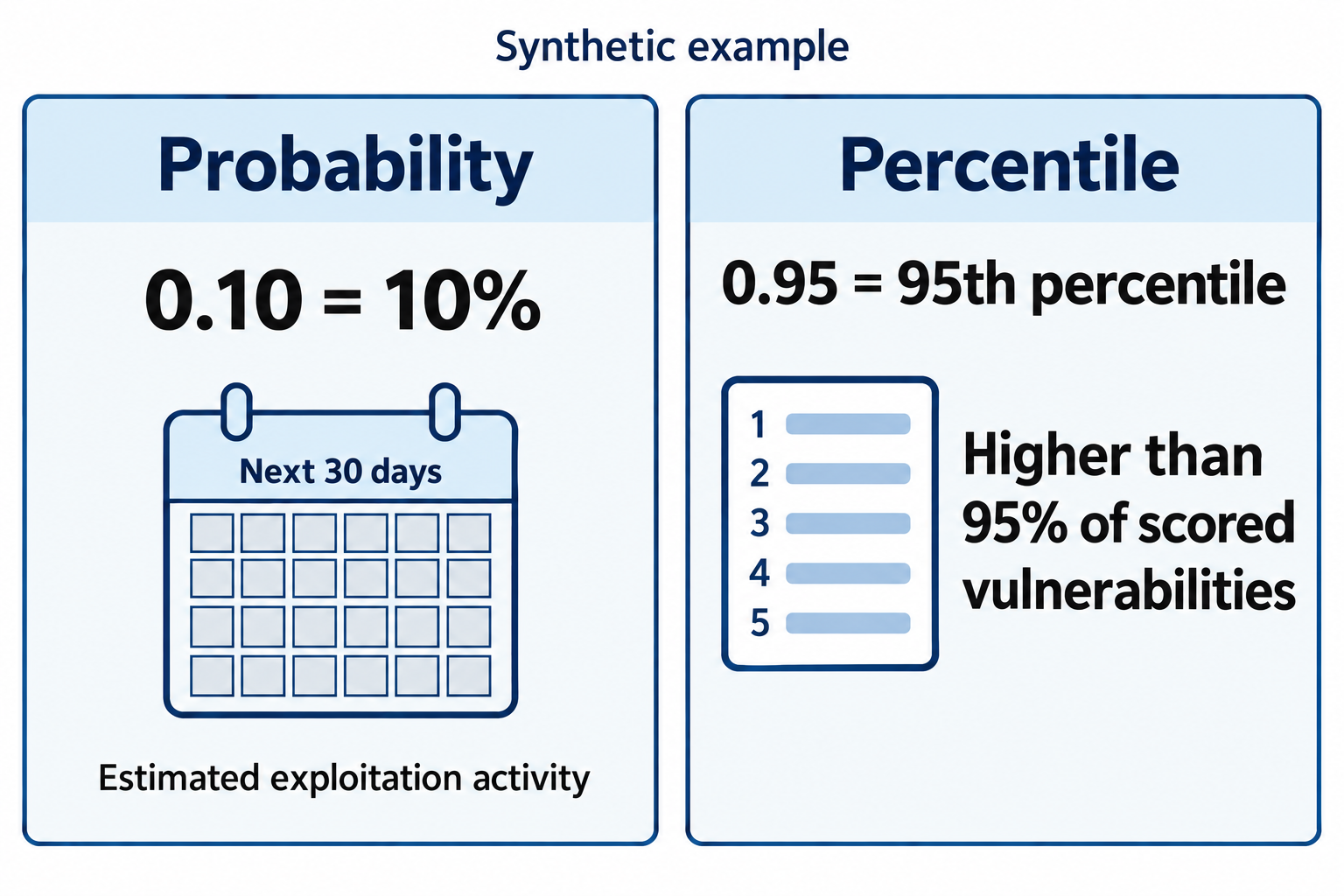
Figure 8.5: The Exploit Prediction Scoring System (EPSS) reports both a probability of exploitation in the next 30 days and a percentile rank among scored vulnerabilities. These values answer different questions.
Text description for Figure 8.5
In this synthetic example, an EPSS probability of 0.10 means an estimated 10 percent chance of exploitation activity in the wild during the next 30 days. A percentile of 0.95 places that score above 95 percent of currently scored vulnerabilities. Their relationship varies as the scored population changes. Neither number proves exploitation on a particular organization’s asset. Confirmed exploitation reports and local evidence are separate inputs to prioritization.
Combining CVSS and EPSS in Prioritization
Smart organizations use both frameworks:
- High CVSS + Low EPSS: A severe vulnerability that is unlikely to be exploited soon. Example: A vulnerability requiring extensive prerequisites that are rare in the wild. Remediation is important but can be scheduled in normal maintenance windows.
- Low CVSS + High EPSS: A relatively mild vulnerability that is being actively exploited. Example: A phishing-based vulnerability or a weakness in widely-deployed software that attackers have weaponized. Remediation is urgent despite low severity scores.
- High CVSS + High EPSS: Critical threat requiring immediate attention. Example: ProxyLogon (CVE-2021-26855) or Log4Shell (CVE-2021-44228).
- Low CVSS + Low EPSS: Lower priority. Remediation can be handled in regular maintenance cycles.
8.4 Context Awareness in Prioritization
CVSS and EPSS provide starting points, but organizational context dramatically shapes prioritization decisions.
Internal versus Internet-Facing Systems
Systems facing the internet directly (web servers, VPN endpoints, email gateways) are exploitable by attackers anywhere. Vulnerabilities in these systems demand faster remediation because the attack surface is global. Conversely, vulnerabilities in systems accessible only over the internal network are less immediately exposed, although insider threats, compromised endpoints, and lateral movement scenarios still create risk.
An internet-facing vulnerability with CVSS 5.0 might be higher priority than an internal vulnerability with CVSS 7.0 because the internet-facing system is continuously probed by scanning and attack traffic.
Network Segmentation and Isolation
Network segmentation acts as a powerful compensating control. A vulnerability in a system on a segregated network accessible only through a jump host has lower exploitation likelihood than the same vulnerability on an openly networked system. Organizations with mature network segmentation can sometimes defer remediation of lower-risk vulnerabilities in isolated systems.
However, segmentation is often assumed but not verified. Penetration tests and breach investigations regularly reveal that systems believed to be isolated are actually reachable through overlooked routing, VPN access, or insecure segmentation controls.
Figure 8.6 separates access-path exposure from business impact.
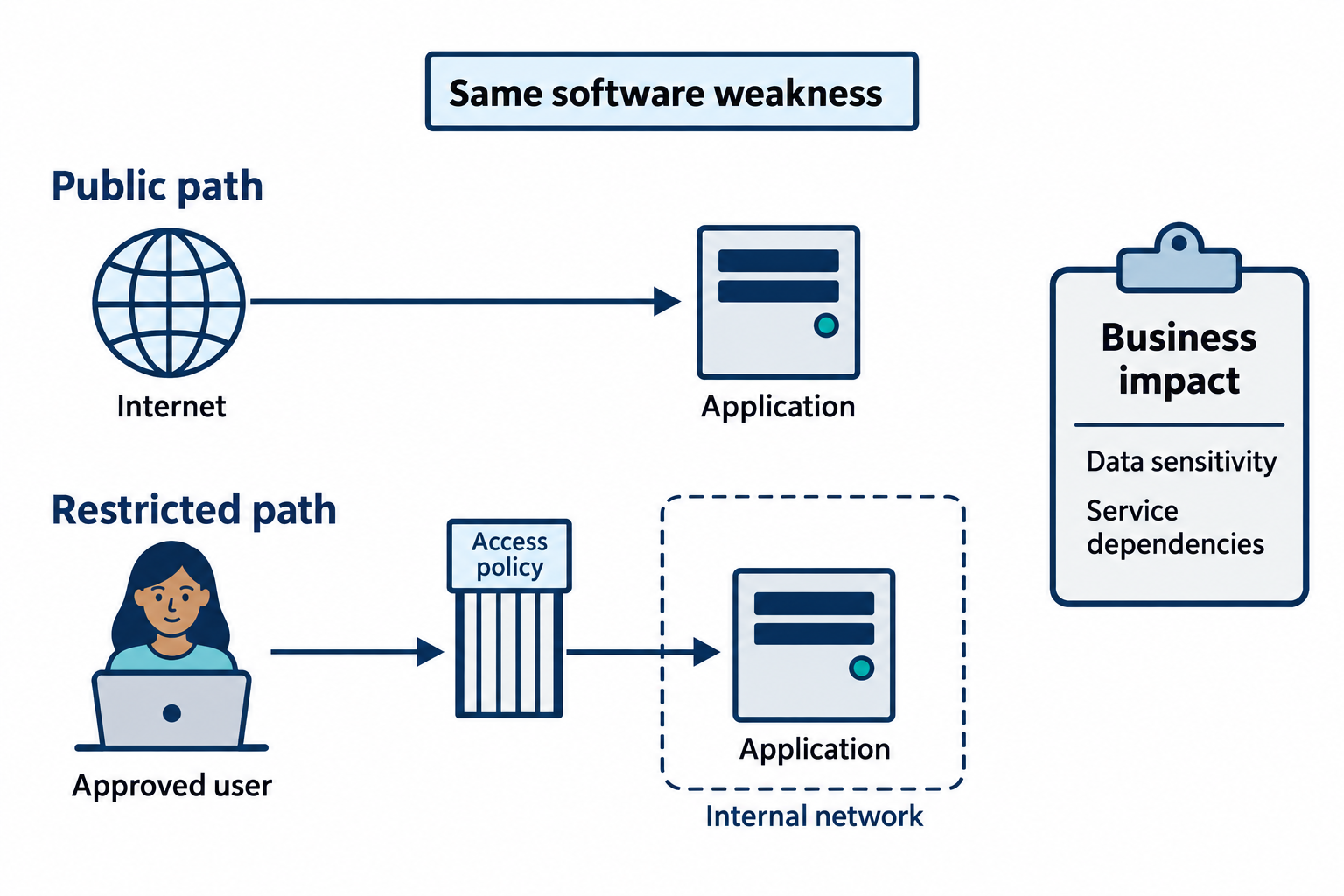
Figure 8.6: Access paths change exposure. Asset criticality describes the consequences of losing or compromising the service, and still requires business analysis.
Text description for Figure 8.6
The upper route allows an internet client to reach a public application. The lower route requires an approved access path through a policy control before reaching an internal copy of the application. Verify actual routes, identities, and firewall rules before relying on segmentation. Internal access remains possible through permitted users or compromised systems. Assess data sensitivity and service dependencies for both deployments; isolation does not by itself change the value of the business function.
Asset Criticality and Business Function
Asset classification provides context:
- Tier 1 (Critical): Revenue-generating systems, core infrastructure, systems processing sensitive data. Vulnerabilities in these systems are highest priority regardless of CVSS scores.
- Tier 2 (Important): Systems supporting business operations, internal applications, data repositories. Moderate priority; remediation should occur within normal maintenance windows.
- Tier 3 (Standard): General-purpose systems, lower-risk applications. Standard remediation timelines.
- Tier 4 (Non-Critical): Development, testing, or ancillary systems. Can tolerate longer remediation timelines unless otherwise mandated by regulation.
8.5 Mitigation Strategies
Once vulnerabilities are prioritized, mitigation strategies must be selected. Patching is the most direct approach, but other strategies exist and are sometimes more practical.
Patching and Updates
Patch deployment is the standard vulnerability remediation approach. Organizations develop patch management processes that include:
- Testing in non-production environments: Patches are applied to test systems first to ensure they do not break applications or introduce regressions.
- Scheduled deployment windows: Changes are scheduled during maintenance periods when outages are less disruptive.
- Rollback procedures: If a patch causes problems, the change can be reverted.
- Verification and validation: After patching, verification scanning confirms that the vulnerability has been remediated.
Figure 8.7 follows a patch through preparation, testing, deployment, and verification.
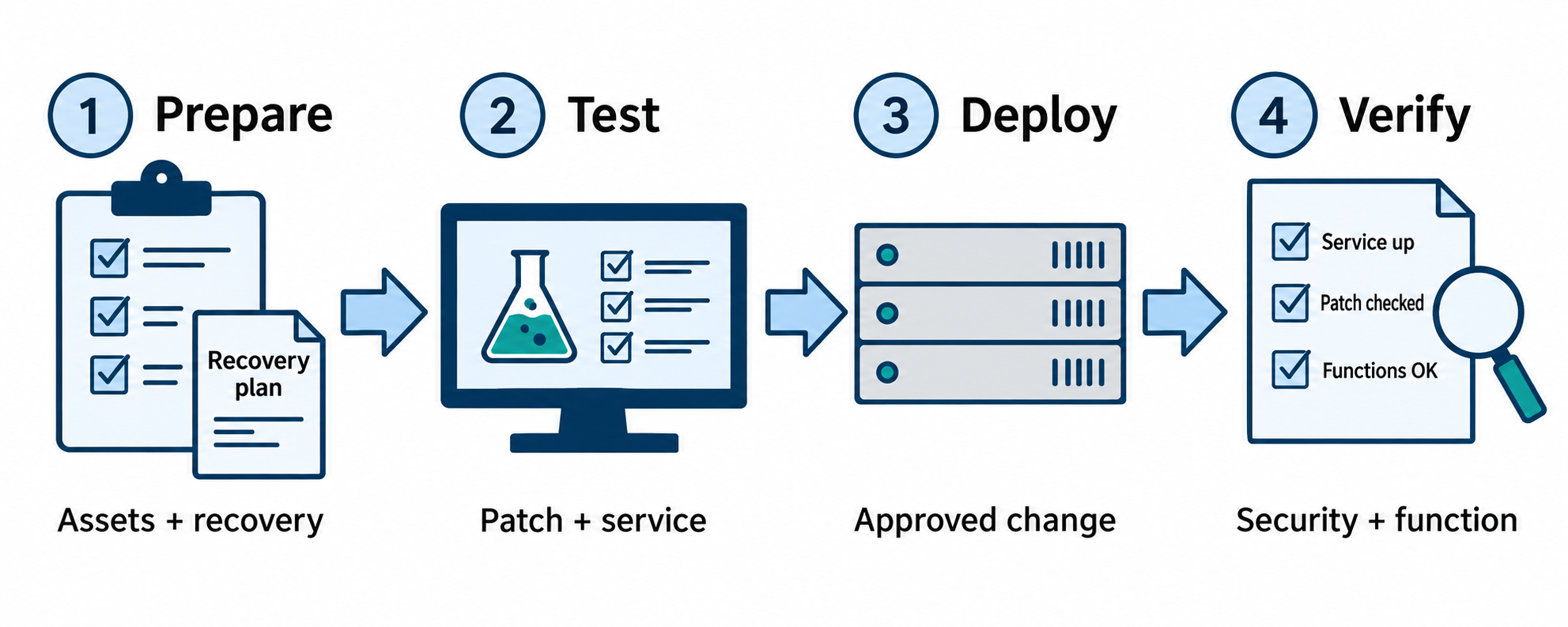
Figure 8.7: A patch change includes preparation, testing, controlled deployment, and verification. Recovery planning accounts for the risk of reintroducing a vulnerability during rollback.
Text description for Figure 8.7
Prepare by confirming affected assets, trusted update sources, dependencies, backups, and the proposed recovery procedure. Test the update and key service functions. Deploy through the approved change process, using urgency and exposure to choose a suitable sequence. Verify installed state, targeted security checks, and service behavior. If recovery requires rollback, reassess the restored vulnerability and apply appropriate interim controls rather than treating rollback as a secure final state.
Challenges include:
- Patch windows and system criticality: Critical systems sometimes cannot be patched without affecting business operations. Patches might need to be applied during non-business hours or during scheduled maintenance.
- Compatibility and regression risk: Some patches introduce new bugs or break legitimate functionality. This risk must be assessed and accepted or mitigated through extensive testing.
- Vendor patch lag: Vendors sometimes take weeks or months to release patches, especially for open-source projects with limited resources.
- Cascading dependencies: Patching one component sometimes requires patching dependent systems. A library update might require application recompilation or testing.
Attack Surface Management
Attack surface reduction addresses vulnerabilities by eliminating exposure rather than patching. Strategies include:
- Disabling unnecessary services: Many operating systems and applications run services by default that are not used. Disabling unused services (Windows SSDP, unnecessary ports) eliminates potential vulnerabilities in those services.
- Removing unnecessary software: Uninstalling unneeded applications eliminates their vulnerabilities entirely.
- Firewall and network access controls: Restricting access to vulnerable services using firewalls, network segmentation, or WAF rules reduces attack surface. A vulnerability in an internal service can be remediated by restricting network access rather than patching.
- Configuration hardening: Many vulnerabilities exist because systems are misconfigured with overly permissive defaults. Hardening configurations, disabling unnecessary authentication methods, enforcing strong TLS versions, restricting API access, reduces exposure.
- Least privilege: Running services with the minimum required permissions reduces the impact if a vulnerability is exploited.
Figure 8.8 compares changes that address the weakness, exposure, or impact.
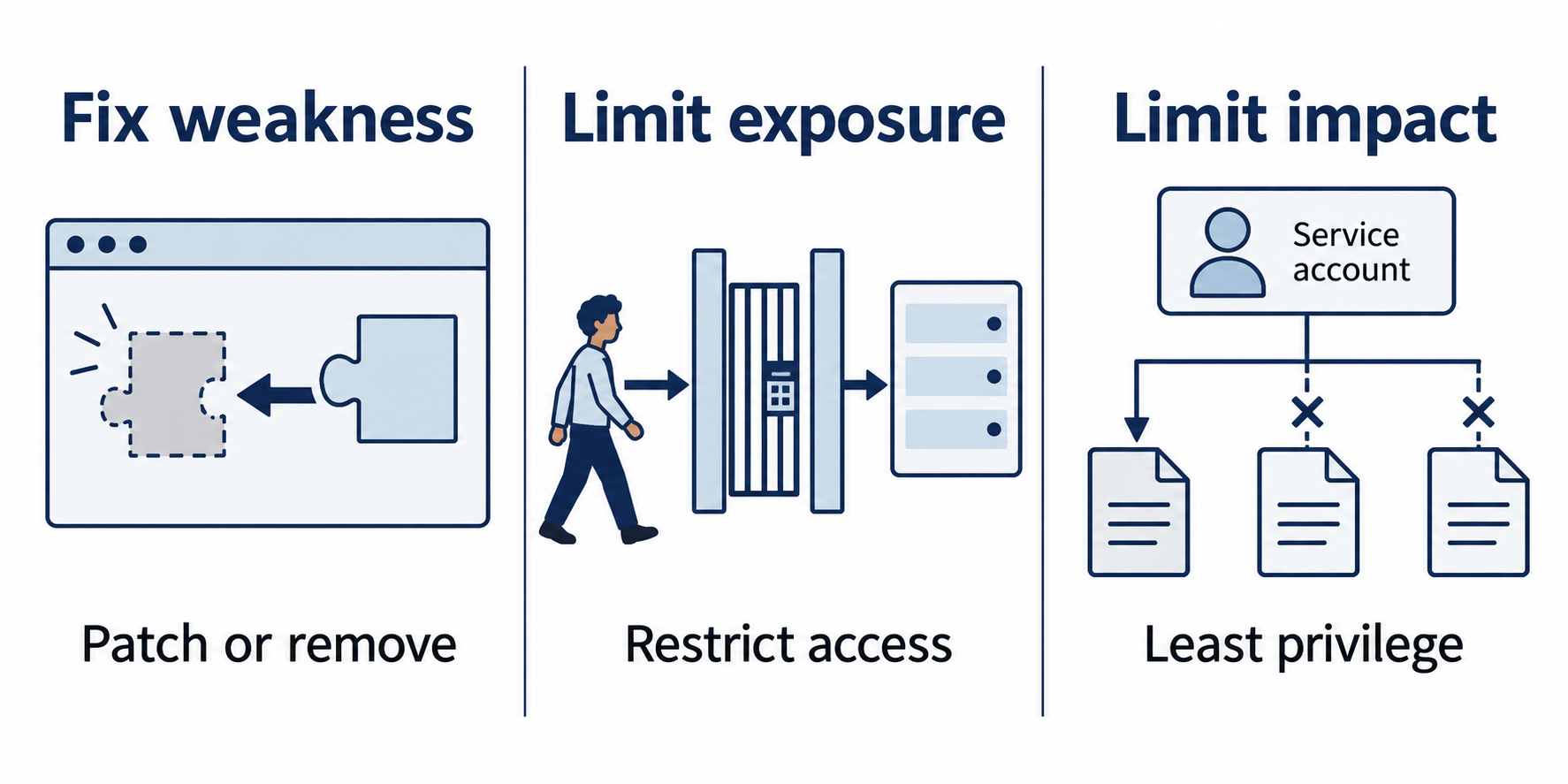
Figure 8.8: Different changes address different parts of risk: fix the weakness, limit access to it, or limit what a successful exploit can do.
Text description for Figure 8.8
Applying an effective patch, correcting vulnerable code, or removing an unnecessary affected component can address the weakness itself. Network policy, service disabling, and hardening can reduce exposure, depending on the flaw and deployment. Least privilege limits the actions available to a compromised service. A firewall rule alone generally leaves the underlying software flaw present. Monitoring supports detection and response, and does not by itself block exploitation.
Secure Coding and Shift-Left
For organizations developing custom applications, secure coding practices and shift-left testing address vulnerabilities at the source:
- Static Application Security Testing (SAST) in CI/CD pipelines: Code is scanned during development to identify vulnerabilities before they reach production.
- Code review and security design review: Developers and security experts review code and architecture to identify and fix vulnerabilities.
- Dependency management: Libraries and frameworks are scanned for known vulnerabilities, and updates are deployed promptly.
- Secure coding training: Developers are trained in common vulnerability classes (injection, cross-site scripting, weak cryptography) and how to avoid them.
Compensating Controls
When patches are unavailable or patching creates unacceptable risk, compensating controls mitigate vulnerabilities:
- Network-level controls: WAF rules, IPS signatures, firewall rules that block exploitation traffic. Example: blocking HTTP methods that trigger a vulnerability, even though the vulnerability exists.
- Application-level controls: Input validation, rate limiting, authentication enforcement that prevent exploitation even if the underlying vulnerability exists.
- Monitoring and alerting: Enhanced logging and alerting for exploitation attempts, enabling rapid response if attacks occur.
- Temporary solutions: Workarounds that address the vulnerability until a permanent patch is available.
Compensating controls are not permanent solutions. They require ongoing maintenance and monitoring. The goal is to bridge the gap until a proper patch or remediation is available.
Compensating Control Fatigue
Organizations sometimes accumulate so many compensating controls that systems become unmaintainable: multiple layers of WAF rules, application-level workarounds, custom patches, and monitoring logic. Periodically audit compensating controls and prioritize moving to permanent remediation (vendor patches, system upgrades, architectural redesign) rather than indefinite reliance on workarounds.
Risk Acceptance and Exceptions
Not every vulnerability is remediated. Organizations sometimes formally accept vulnerability risk through an exception process:
- Business justification: The cost or operational impact of remediation exceeds the accepted risk.
- Risk appetite: The organization's risk tolerance allows deferring remediation of lower-impact findings.
- Temporary acceptance: Risk acceptance might be time-limited while planning for future remediation.
- Compensating controls in place: The organization accepts risk because compensating controls sufficiently mitigate the threat.
- Executive sign-off: Risk acceptance decisions are documented and approved by appropriate stakeholders.
Risk acceptance is legitimate governance when done deliberately and documented. It becomes problematic when it becomes routine or reflects negligence rather than deliberate decision-making.
Figure 8.9 shows what a managed temporary exception needs to record.
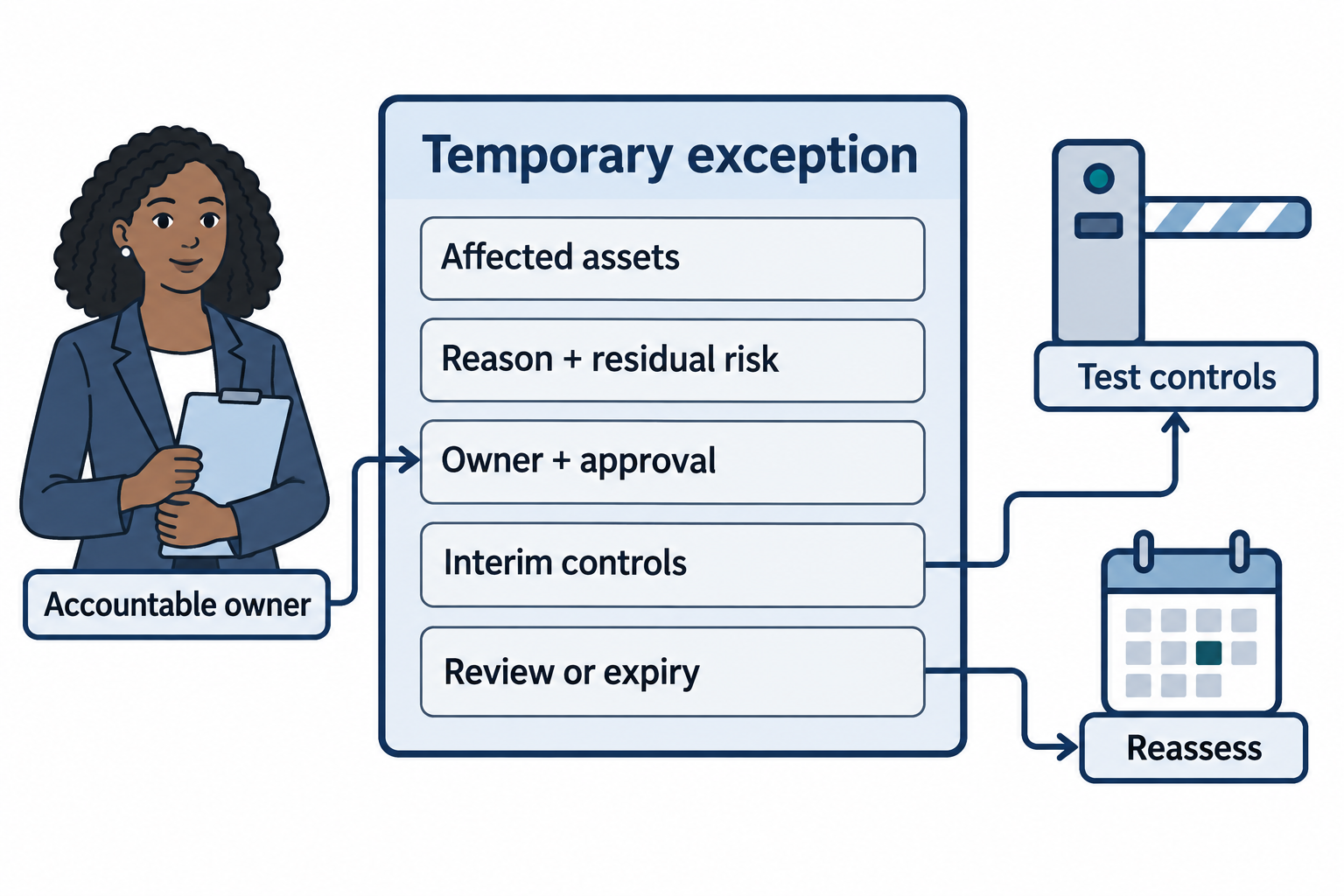
Figure 8.9: A managed exception records residual risk, an accountable owner, interim controls, and a date or trigger for reassessment.
Text description for Figure 8.9
An exception documents the affected assets and finding, the business reason for delaying a change, the risk that remains, and approval by the authorized risk owner. Record any compensating controls and how their operation was tested. Set a review or expiry date and triggers such as active exploitation, a failed control, or a newly available fix. Monitoring helps detect trouble while the exception remains open. Acceptance is a governance decision and does not remove the vulnerability.
8.6 Validation of Remediation
Once remediation is implemented, verification confirms effectiveness. Validation includes:
Verification Methods
- Re-scanning: The same vulnerability scanner that identified the vulnerability re-scans the system. If the scanner no longer reports the vulnerability, remediation is effective.
- Independent verification: Third-party scanning or penetration testing confirms the vulnerability has been resolved, reducing confirmation bias.
- Manual testing: For critical vulnerabilities, hands-on penetration testing attempts exploitation to confirm the fix actually works.
- Regression testing: Applications or systems are tested to ensure patching did not break functionality.
Evidence Collection and Documentation
Remediation evidence should be collected for compliance and audit:
- Patch deployment logs: Automated patch management tools provide logs showing which patches were applied to which systems on which dates.
- Scanner reports: Before and after vulnerability scans showing vulnerability cleared.
- Change management records: Documentation of what changed, when, and approvals for the change.
- Testing results: Evidence that regression testing was performed and applications continue functioning.
- Sign-off documentation: Approval from relevant stakeholders that remediation is complete.
Figure 8.10 brings together evidence for a remediation closure decision.
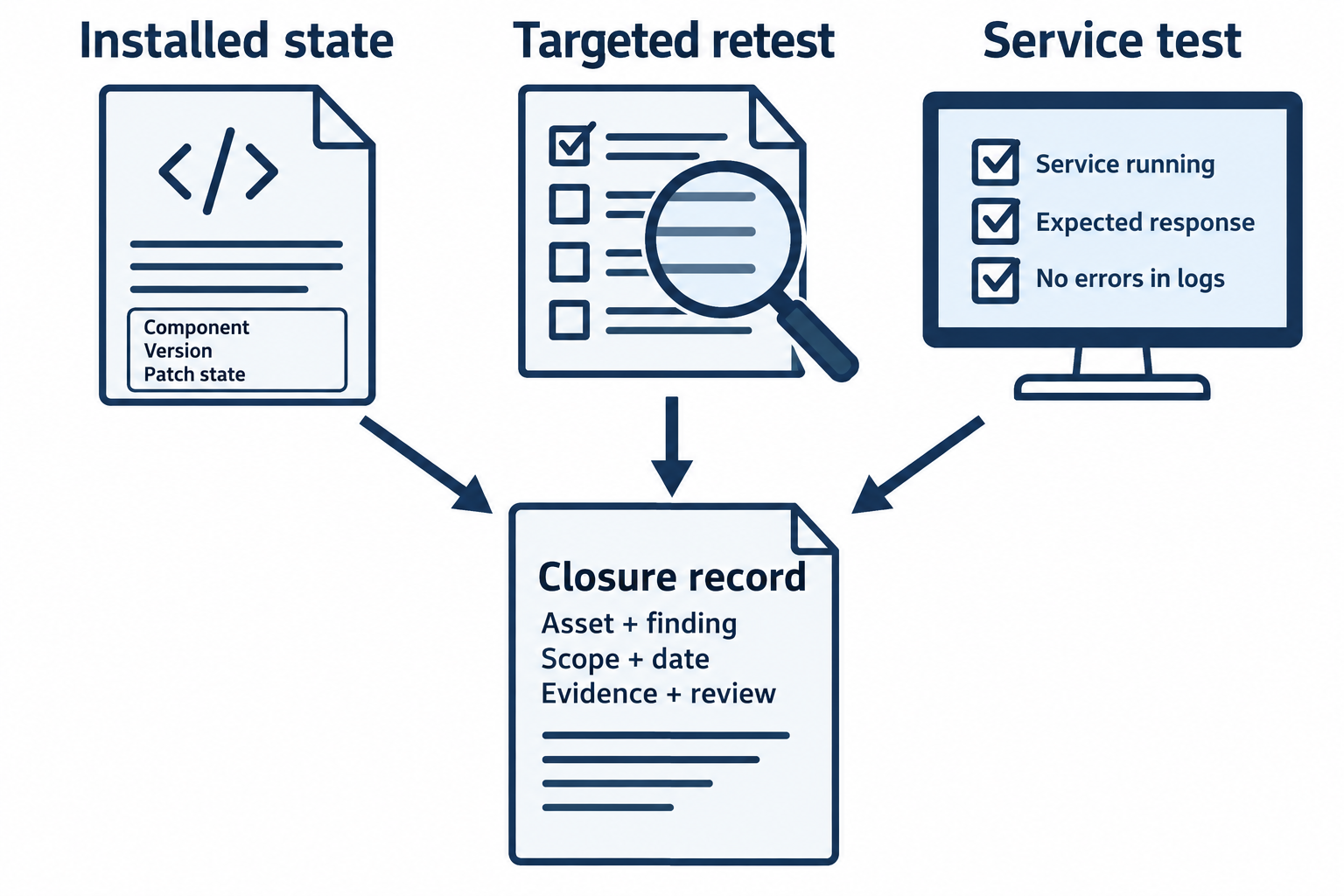
Figure 8.10: Close a finding using evidence that the intended change succeeded, the security check is valid, and the service still works.
Text description for Figure 8.10
Match the change to the original asset and finding. Confirm installed package or configuration state, rerun an appropriate check with working access and credentials, and test expected service behavior. Keep before-and-after results, change details, test scope, dates, and reviewer decisions. A clean scanner report with failed credentials or an unreachable host cannot support closure. Security validation of a patch also does not prove the absence of an earlier compromise.
Metrics and Compliance
Organizations track remediation metrics:
- Mean Time to Remediation (MTTR): Average time from vulnerability discovery to remediation completion. This varies by criticality; critical vulnerabilities might have 48-hour MTTR while moderate vulnerabilities might have 30-day MTTR.
- Remediation rate: Percentage of identified vulnerabilities that are remediated (as opposed to accepted or deferred).
- Coverage: Percentage of systems included in vulnerability scanning. Coverage gaps represent blind spots.
8.7 Putting It Together: ProxyLogon Response Timeline
Scenario: It is March 3, 2021. Your organization operates an on-premises Microsoft Exchange deployment with 500 mailboxes serving your primary business. At 7 a.m., your security team receives an alert from your threat intelligence platform that Microsoft has released security patches for multiple critical vulnerabilities (CVE-2021-26855, CVE-2021-27065, CVE-2021-26858, CVE-2021-27086) affecting Exchange Server 2013, 2016, and 2019. The vulnerabilities have CVSS 9.8 and require no authentication. Within hours, evidence emerges that nation-state and cybercriminal groups are actively exploiting these vulnerabilities to install web shells and access mailbox data.
Prioritization Analysis:
- Exploitability: CVSS 9.8; public POC; no authentication required; no user interaction required. Exploitability is maximal.
- Active Exploitation: Confirmed within 12 hours. EPSS would be 99+.
- Asset Value: Exchange is critical infrastructure; email is essential business function; potential access to sensitive corporate communications.
- Impact: Confidentiality (access to all email), Integrity (ability to modify email), Availability (ability to disable exchange). All three are maximum.
- Patch Availability: Microsoft released patches on March 2, 2021. Patches are available.
- Patch Feasibility: Exchange deployment is critical and cannot be taken offline for extended testing.
Decision: Emergency patching is required immediately, beginning with internet-facing Exchange servers (if any) and proceeding to internal Exchange servers within 24 hours, accepting higher risk of regression due to compressed testing timelines.
Actions:
- Hour 0–2: Team members are notified. A rapid assessment determines that your organization's Exchange servers are accessible from the internet (basic exposure analysis).
- Hour 2–4: Patches are downloaded and applied to a test Exchange server in a lab environment. Basic functionality testing (email send/receive, calendar) is performed. The patches are verified to apply cleanly without version conflicts.
- Hour 4–6: Patches are applied to internet-facing Exchange servers during the day (operational necessity overrides normal maintenance windows).
- Hour 6–24: Remaining Exchange servers are patched during normal maintenance windows.
- Hour 24: All systems are re-scanned to confirm vulnerability resolution.
- Hour 24+: Network-based scanning tools (Shodan, Censys) are used to verify that no other organizations' external indicators suggest your Exchange servers were compromised during the vulnerability window.
Figure 8.11 shows exposure reduction and compromise investigation as concurrent response work.
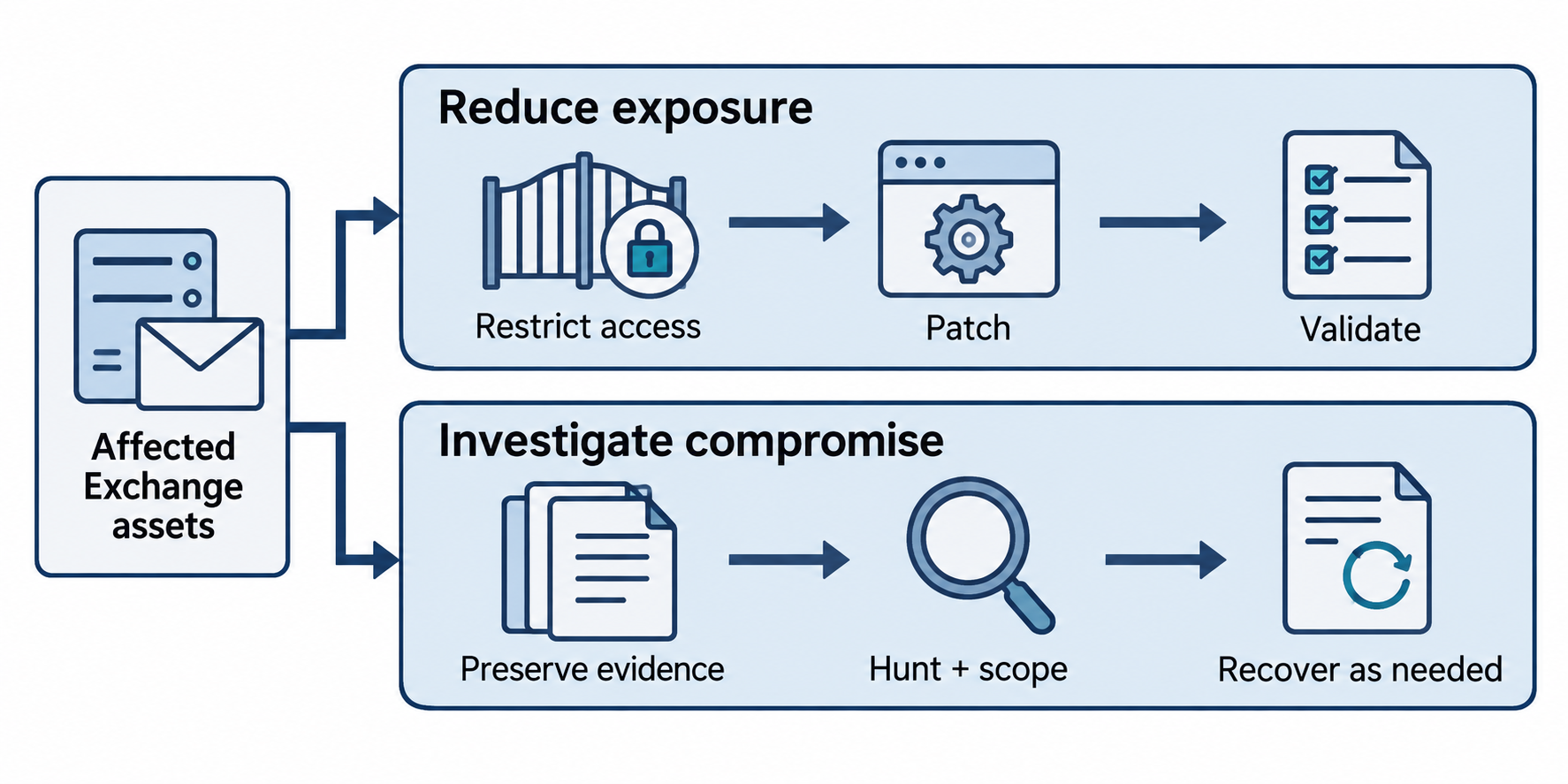
Figure 8.11: The 2021 Exchange response required both urgent exposure reduction and investigation for earlier compromise. Patching does not remove an attacker’s existing foothold.
Text description for Figure 8.11
After identifying affected Exchange assets, reduce exposure and apply the appropriate vendor updates, then validate the update and service function. In parallel, preserve available evidence and investigate logs, suspicious files, web shells, and identity activity. An intrusion finding requires incident response, including scoping and recovery decisions. Public internet search engines can inform exposure discovery but cannot establish that a system was never compromised. The tracks illustrate responsibilities and do not impose the fictional scenario’s hour-by-hour schedule.
Compensating Controls While Patching:
- Network access to Exchange is restricted to known internal IP ranges via firewall rule.
- Exchange-specific IPS signatures are enabled to detect exploitation attempts.
- Enhanced logging of Exchange admin access is enabled.
Outcome: All Exchange servers are patched within 24 hours. The organization successfully prevents compromise during a period when thousands of organizations worldwide were being exploited. The compressed testing timeline introduces minor risk, but that risk is accepted given the operational threat.
Chapter Summary
-
Vulnerability prioritization bridges the gap between unlimited vulnerability findings and limited remediation resources by establishing criteria for deciding which vulnerabilities demand immediate attention.
-
Prioritization criteria include exploitability, active exploitation indicators, asset value, business impact, patch availability, and verification status. No single criterion determines priority; decisions incorporate multiple dimensions of risk.
-
CVSS provides standardized severity scoring (0–10) based on technical metrics but lacks business context and does not predict actual exploitation likelihood.
-
EPSS predicts exploitation probability using machine learning and threat intelligence, offering complementary information to CVSS. Organizations using both frameworks make more effective prioritization decisions.
-
Organizational context shapes prioritization: internet-facing systems, asset criticality, network segmentation, and business dependencies all influence urgency independent of raw CVSS scores.
-
Mitigation strategies extend beyond patching. Attack surface reduction, compensating controls, secure coding, and formal risk acceptance all address vulnerabilities appropriately to organizational context.
-
Verification and documentation confirm remediation effectiveness and create audit evidence. Mean Time to Remediation (MTTR) and coverage metrics track organizational maturity in vulnerability management.