CH11: Salary Negotiations — Knowing Your Worth and Communicating It
Introduction
You have spent the previous ten chapters building every component of a competitive candidacy: understanding the business value of cybersecurity, mapping job roles, inventorying your skills, engineering a resume, building a personal brand, earning certifications, preparing for both behavioral and technical interviews, understanding governance and compliance career paths, and protecting your mental health as a working analyst. There is one more skill this course needs to address before you enter the workforce, and it is the one that most students are least prepared for: negotiating your compensation.
Salary negotiation is not haggling. It is a professional conversation between two parties who have already decided they want to work together. By the time an employer extends an offer, they have invested significant time and money in sourcing, screening, interviewing, and selecting you. They want you to accept. That dynamic gives you more leverage than you might expect, even as an entry-level candidate.
This chapter will not tell you what number to ask for. Compensation varies too widely by role, geography, industry, clearance status, and organizational budget for any single figure to be useful. What this chapter will do is equip you with a repeatable framework: how to research your market value using credible data sources, how to evaluate a total compensation package beyond the base salary number, how to prepare a negotiation position grounded in evidence rather than guesswork, and how to conduct the conversation itself with professionalism and confidence. These are skills you will use at every career transition, not just your first one.
Learning Objectives
By the end of this chapter, you will be able to:
- Identify reputable sources for researching cybersecurity compensation data at various career levels, geographies, and industry sectors.
- Distinguish between base salary and total compensation by evaluating benefits, bonuses, retirement contributions, and non-monetary perks.
- Apply a structured preparation framework to build a data-backed negotiation position before any salary conversation.
- Demonstrate professional negotiation techniques for common scenarios including initial offers, counteroffers, and competing offers.
- Recognize when and how to negotiate non-salary elements of a compensation package, particularly in government and contract roles where salary bands may be fixed.
11.1 Why Negotiation Matters (Even at Entry Level)
There is a persistent belief among students and early-career professionals that negotiation is something senior people do. The reasoning goes: "I'm just starting out, I should be grateful for any offer, and pushing back might get the offer rescinded." Every part of that reasoning is flawed, and understanding why is the foundation for everything that follows in this chapter.
The Compounding Effect of Your Starting Salary
Your starting salary is not a single number that applies to a single year. It is the baseline from which every future raise, bonus, and promotion is calculated. Most organizations determine annual raises as a percentage of current salary. If you start at $50,000 and receive a 3% annual raise, your salary after five years is approximately $57,964. If you had negotiated a starting salary of $55,000, that same 3% annual raise puts you at $63,760 after five years. The $5,000 difference at the starting line became a $5,796 gap after five years, and it continues to widen with every subsequent raise, bonus calculation, and job transition where your previous salary influences the new offer.
Over a 30-year career, research from compensation economists has estimated that failing to negotiate your first salary can cost between $500,000 and $1,000,000 in cumulative lost earnings.
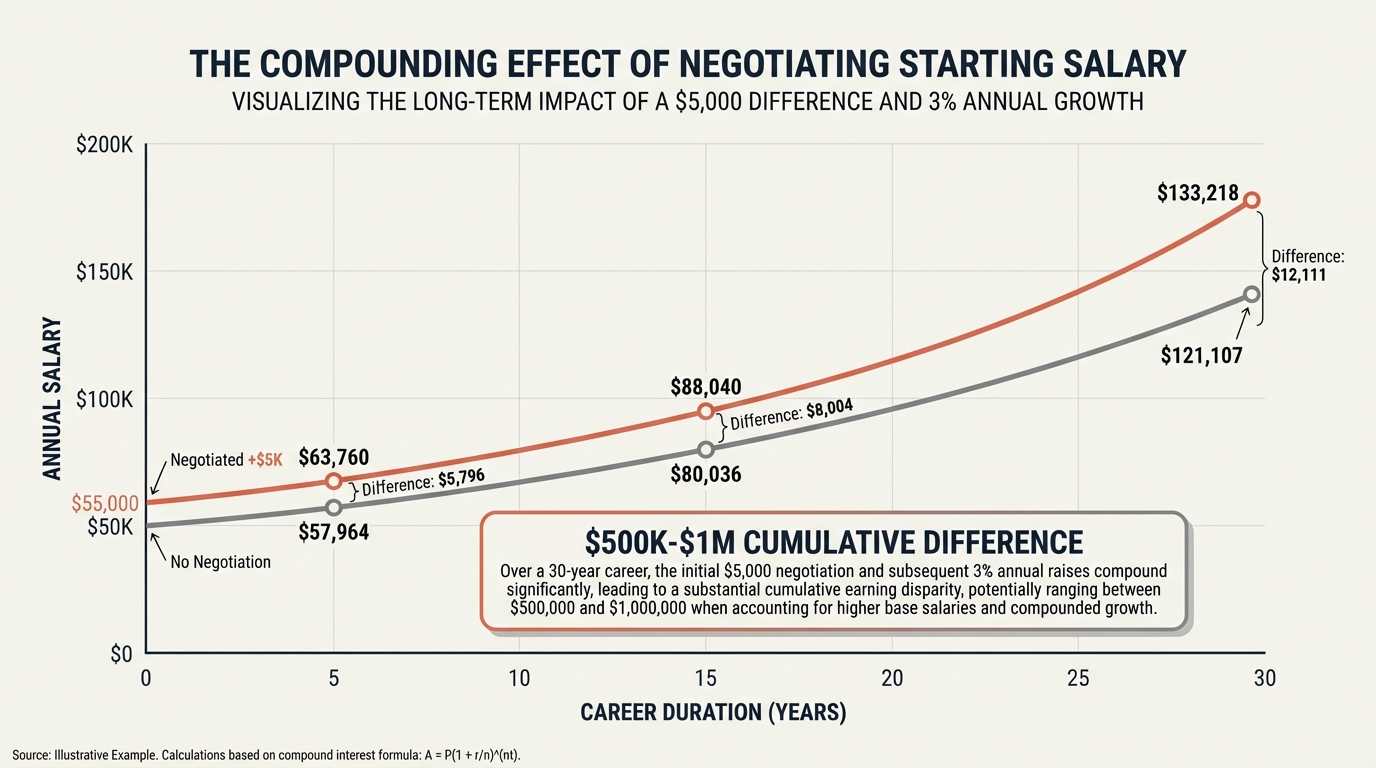 The exact number depends on your field, raise percentages, and career trajectory, but the principle is consistent: small differences at the start produce large differences over time.
Employers Expect It
Hiring managers and HR professionals build negotiation room into their offers. When an employer extends an offer at $52,000, they have almost certainly been authorized to go higher. The initial offer is a starting position, not a final position. Employers who rescind offers because a candidate attempted a professional, good-faith negotiation are exceptionally rare, and an organization that would penalize you for advocating for yourself is revealing something important about its culture.
That said, there is a difference between negotiation and demand. Negotiation is a collaborative conversation where you present evidence for why a different number is appropriate. A demand is an ultimatum. This chapter teaches the former.
Analyst Perspective
Talk to working professionals in the field before your first negotiation. You will hear the same story repeatedly: "I wish I had negotiated my first offer." Very few professionals look back and regret having asked. Many look back and regret not asking. This pattern holds across industries, but it is especially pronounced in cybersecurity, where the talent shortage gives candidates more leverage than they often realize.
Salary History and Transparency Laws
The legal landscape around salary disclosure has shifted significantly in recent years. A growing number of states and municipalities have enacted salary history bans, which prohibit employers from asking candidates about their previous compensation. The intent behind these laws is to prevent historical pay inequities from following workers from job to job. If you were underpaid at your previous employer, a salary history ban ensures that underpayment does not anchor your next offer.
Separately, pay transparency laws in several states now require employers to disclose the salary range for a position in the job posting or upon request. These laws give you a significant advantage in negotiation because you can see the employer's authorized range before the conversation starts.
Before any salary conversation, research the specific laws in your state (or the state where the position is located, for remote roles). Knowing whether an employer can legally ask about your salary history, and whether they are required to disclose the pay range, changes the dynamics of the negotiation.
Warning
Even in states without salary history bans, you are not obligated to disclose your current salary. If asked, you can redirect with: "I'd prefer to focus on the value I bring to this role and the market rate for this position." This is a professional and widely accepted response. Do not volunteer a number that could be used to anchor your offer below market value.
11.2 Researching Your Market Value
Effective negotiation starts with data, not instinct. Before you ever discuss compensation with an employer, you need to know what the market pays for the role you are pursuing, adjusted for your geography, experience level, industry sector, and any special qualifications like security clearances. This section walks through the sources available to you and how to use them.
Compensation Data Sources
Not all salary data is created equal. Some sources survey employers directly, some aggregate self-reported employee data, and some combine both. Each has strengths and limitations. The following table compares the most useful sources for cybersecurity compensation research.
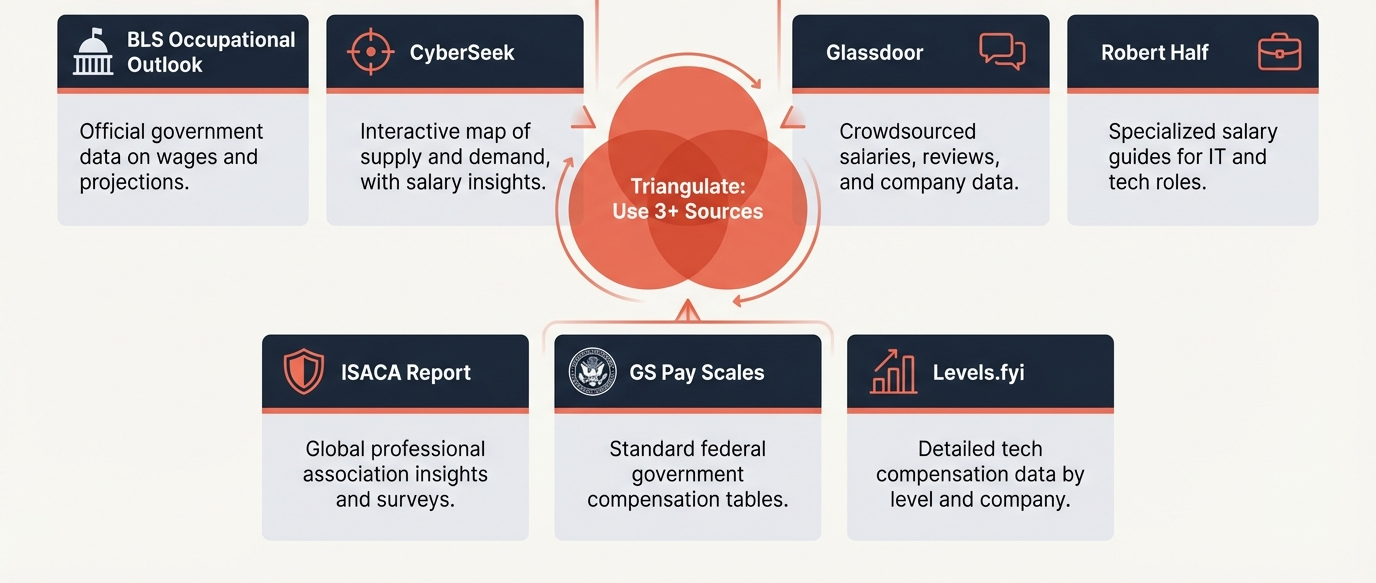
| Source | What It Covers | Strengths | Limitations |
|---|---|---|---|
| Bureau of Labor Statistics (BLS) Occupational Outlook Handbook | National and state-level median wages by occupation | Government-collected, large sample sizes, updated annually | Broad occupational categories; does not distinguish between SOC analyst and CISO |
| CyberSeek (NICE/CompTIA) | Cybersecurity-specific roles, supply/demand data, career pathway mapping | Purpose-built for cyber workforce; maps to NICE Framework roles | Salary data is aggregated from job postings, not verified employer data |
| Glassdoor | Self-reported salaries by company, role, and location | Company-specific data; large volume of reports | Self-reported data can be skewed; sample sizes vary by company |
| Levels.fyi | Detailed compensation breakdowns (base, bonus, equity) by company and level | Granular total compensation data; strong for tech companies | Skews toward large tech firms; limited coverage of government, education, small/mid orgs |
| Robert Half Salary Guide | IT and cybersecurity salary ranges by role and region | Published by a major staffing firm; includes demand trends | Ranges can be broad; may reflect staffing firm placement rates rather than direct-hire offers |
| ISACA State of Cybersecurity Report | Global compensation data for cybersecurity and GRC professionals | Survey of practicing professionals; includes benefits and satisfaction data | Published annually; may lag current market by 6-12 months |
| LinkedIn Salary Insights | Role-based salary estimates with geographic and industry filters | Integrated with job postings; large dataset | Requires LinkedIn account; data quality varies by region |
| PayScale | Self-reported salaries with cost-of-living adjustments | Free access to basic data; comparison tools | Smaller sample sizes than Glassdoor for niche cybersecurity roles |
| Government pay scales (GS, state equivalents) | Exact salary tables for federal and state government positions | Precise and public; includes locality pay adjustments | Only applies to government roles; does not include contractor rates |
How to Use These Sources Effectively
No single source gives you a complete picture. The recommended approach is triangulation: pull data from at least three sources that cover your target role, geography, and experience level, then identify where the ranges overlap. That overlap zone is your realistic market range.
Step 1: Define your target role precisely. "Cybersecurity" is not a role. "Tier 1 SOC Analyst in a mid-size financial services company in the Midwest" is a role. The more specific your definition, the more useful your research.
Step 2: Pull ranges from three or more sources. Record the low, median, and high values from each source. Note the date of the data, since salary information older than 18 months may not reflect current market conditions.
Step 3: Adjust for your qualifiers. Certain factors shift your position within the range:
- Security clearance: Holding an active Secret or Top Secret clearance can add 10-20% to market rates for roles that require one, because the clearance itself has significant time and cost to obtain.
- Certifications: Industry-recognized certifications (Security+, CySA+, GCIH, OSCP, etc.) position you higher within a range, especially when they align with the job requirements.
- Specialized skills: Experience with specific tools, platforms, or regulatory frameworks (HIPAA for healthcare, PCI DSS for financial services) can differentiate you.
- Geographic adjustments: A SOC analyst in the San Francisco Bay Area will command a significantly different salary than the same role in rural Ohio. Use cost-of-living calculators alongside raw salary data.
Step 4: Define your range. Based on your triangulated data, set three numbers: your floor (the lowest offer you would accept), your target (the number you will negotiate toward), and your stretch (an optimistic but defensible number for ideal conditions). Write these down. Having them defined before the conversation prevents emotional decision-making in the moment.
Analyst Perspective
Build a simple spreadsheet to track your compensation research. Columns: Source, Role Title, Location, Experience Level, Low, Median, High, Date of Data, Notes. This spreadsheet becomes your evidence file for the negotiation conversation, and you can update it for every job search throughout your career.
11.3 Understanding Total Compensation
The salary number on an offer letter is the most visible component of your compensation, but it is rarely the most important one. Total compensation includes everything the employer provides in exchange for your work: base salary, bonuses, benefits, retirement contributions, professional development support, and non-monetary perks. Two offers with identical base salaries can differ by $15,000-$30,000 or more in total value once you account for the full package.
Components of a Compensation Package
Base salary is your fixed annual pay before taxes. It is the number most people focus on, and it matters, but it is one piece of a larger picture.
Signing bonus is a one-time payment made when you accept the offer or on your start date. Signing bonuses are common in cybersecurity, particularly when an employer is competing with other offers or when the candidate is relocating. Note that signing bonuses are typically subject to a clawback clause: if you leave within 12-24 months, you may be required to repay all or a portion of the bonus.
Annual performance bonus is a variable payment tied to individual or organizational performance metrics. Bonus structures vary widely. Some employers guarantee a target bonus percentage (e.g., 10% of base salary at target performance); others offer discretionary bonuses with no guaranteed floor.
Retirement contributions take several forms. A 401(k) match is the most common in private sector roles. If an employer matches 100% of your contributions up to 6% of your salary, and your base salary is $55,000, that match is worth up to $3,300 per year in additional compensation. Federal employees participate in the Thrift Savings Plan (TSP), which includes an automatic 1% contribution plus a matching structure up to 5% of salary. Pension plans, while less common than they were a generation ago, still exist in some government and large enterprise environments.
Health insurance varies enormously in both coverage and cost-sharing. An employer that covers 90% of premiums for employee-plus-family coverage is providing significantly more value than one that covers 60%. Ask for the benefits summary document during the offer stage, not after you have accepted.
Paid time off (PTO) includes vacation days, sick leave, personal days, and holidays. Some organizations use an accrual model; others use an "unlimited PTO" policy, which sounds generous but in practice often results in employees taking less time off than they would under a defined allotment. Ask about the average number of days employees actually take, not just the policy on paper.
Professional development support includes certification exam fees, training platform subscriptions (SANS, Offensive Security, TryHackMe, etc.), conference attendance, and tuition reimbursement. In cybersecurity, where continuous learning is a career requirement, the value of a strong professional development benefit can easily reach $5,000-$15,000 per year. An employer that funds your SANS training and GIAC certification attempts is investing heavily in your growth.
Remote and hybrid flexibility does not have a direct dollar value, but it has a measurable impact on your quality of life, commuting costs, and geographic flexibility. A fully remote position may allow you to live in a lower cost-of-living area while earning a salary benchmarked to a higher-cost market.
Equity and stock options are more common at private tech companies and startups than at government agencies or MSSPs. If offered equity, understand the vesting schedule (typically four years with a one-year cliff), the current valuation, and the liquidity timeline. Equity in a pre-IPO startup may be worth a great deal or nothing at all.
Public Sector vs. Private Sector vs. Consulting: A Comparison
The composition of a compensation package varies significantly by employer type. The following matrix provides a general comparison for entry-level to mid-level cybersecurity roles.
| Component | Federal Government (GS-7 to GS-12) | State/Local Government | Private Sector (Enterprise) | MSSP / Consulting |
|---|---|---|---|---|
| Base salary | Fixed by GS scale + locality pay; publicly available | Varies by state; often lower than federal | Competitive; negotiable | Variable; often higher base to offset travel/hours |
| Signing bonus | Rare | Very rare | Common | Common, especially for clearance holders |
| Annual bonus | Not typical; step increases instead | Not typical | 5-15% target common | 5-20% target; some tied to utilization rates |
| Retirement | TSP with 5% match + pension (FERS) | State pension systems (varies widely) | 401(k) with 3-6% match typical | 401(k) with variable match |
| Health insurance | FEHB (excellent coverage, shared premium) | Varies; often good | Varies widely by employer | Varies; larger firms competitive |
| PTO | 13-26 days/year based on tenure + 11 federal holidays | Varies by state | 15-25 days/year typical | 15-20 days; utilization expectations may limit actual use |
| Prof. development | Training budgets available; varies by agency | Often limited | Varies; top employers invest heavily | Often strong (billable skill development) |
| Clearance value | Sponsored (major benefit); adds long-term earning power | Rarely applicable | May require; sometimes sponsored | Frequently required; premium pay |
| Work-life balance | Generally strong; predictable hours | Generally strong | Varies by org | Travel and overtime common |
| Job security | Very high | High | Moderate | Moderate; contract-dependent |
Analyst Perspective
When comparing offers from different employer types, build a side-by-side total compensation estimate. Include every component from the table above that has a dollar value, plus your personal valuation of non-monetary benefits. A federal GS-9 position with FERS pension, TSP match, FEHB, and 13+ holidays may be worth more in total compensation than a private sector offer with a $10,000 higher base salary but weaker benefits. The only way to know is to calculate the full picture.
Putting It Together
Jordan is completing the CFS program and receives two offers in the same week. Offer A is a SOC Analyst I position at a regional bank: $54,000 base salary, 5% annual bonus target, 401(k) with 4% match, and 15 PTO days. Offer B is a Junior Cybersecurity Analyst at a federal contractor: $48,000 base salary, $5,000 signing bonus, 401(k) with 6% match, full remote work, and the contractor will sponsor Jordan's Security+ exam and a SANS training course.
At first glance, Offer A pays $6,000 more in base salary. But Jordan builds a total compensation comparison:
| Component | Offer A (Regional Bank) | Offer B (Federal Contractor) |
|---|---|---|
| Base salary | $54,000 | $48,000 |
| Signing bonus (annualized over 2 years) | $0 | $2,500 |
| Annual bonus (at target) | $2,700 | $0 |
| Retirement match (at max contribution) | $2,160 | $2,880 |
| Professional development | $0 (not offered) | ~$10,000 (Security+ and SANS) |
| Commuting costs saved (remote) | $0 | ~$3,000/year |
| Estimated Year 1 total value | $58,860 | $66,380 |
The "lower-paying" Offer B provides approximately $7,500 more in total first-year value, plus certifications and training that increase Jordan's market value for future roles. Jordan accepts Offer B.
11.4 Building Your Negotiation Position
Walking into a salary conversation without preparation is like walking into a technical interview without studying. The outcome depends almost entirely on what you did before the conversation started. This section provides a structured preparation framework you can use for any compensation discussion, from your first offer to your tenth.
The Three-Number Framework
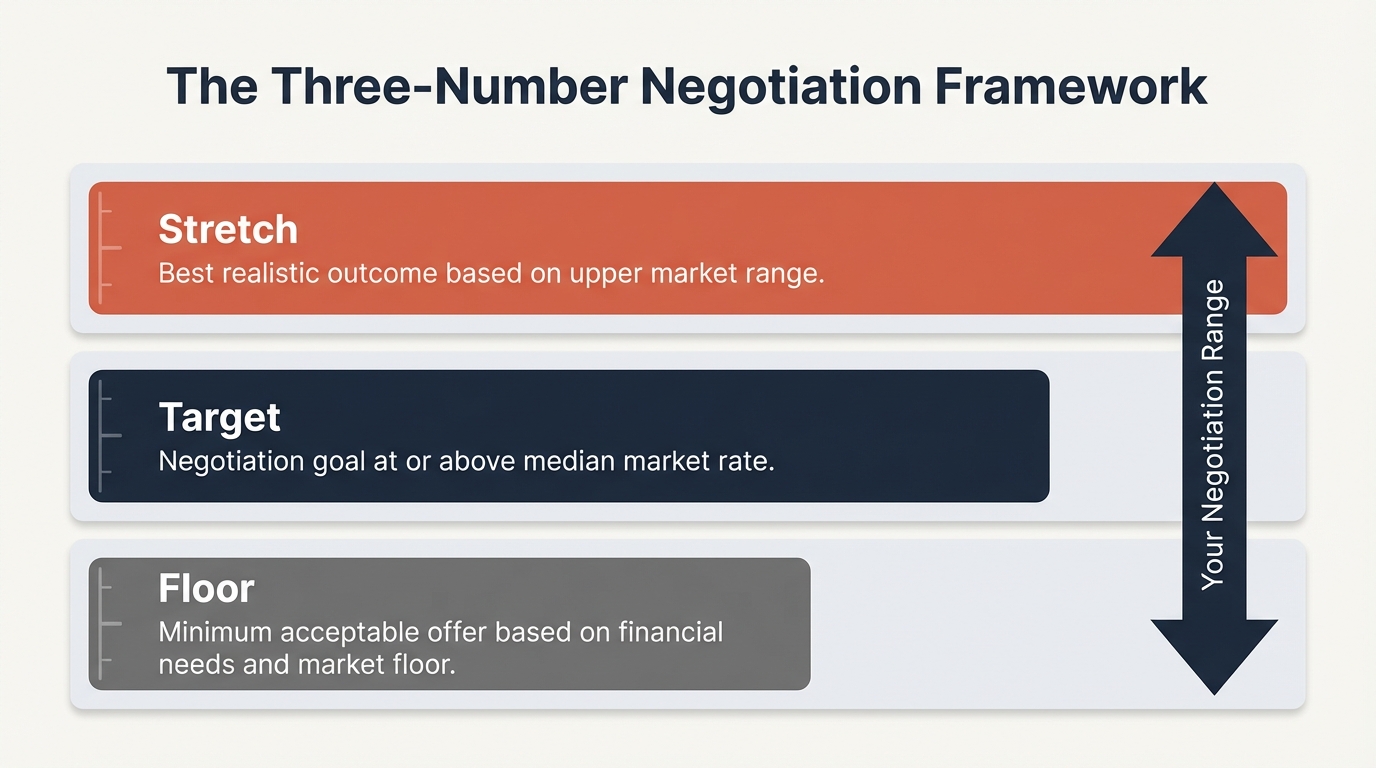
Before any negotiation, define three numbers:
Your floor is the lowest offer you would accept. This number should be based on your financial needs (rent, debt payments, cost of living) and the minimum market rate for the role. If an offer comes in below your floor, you decline or counteroffer. Knowing your floor prevents you from accepting an offer in the moment that you will regret later.
Your target is the number you are negotiating toward. This should be at or slightly above the median market rate for your role, geography, and experience level, adjusted for any differentiators you bring (clearance, certifications, specialized skills). Your target is the number you anchor your counteroffer to.
Your stretch is the best realistic outcome. This is the upper range of market data for candidates with your qualifications in your area. You may not reach your stretch number, but having it defined prevents you from leaving money on the table if the employer is more flexible than expected.
Documenting Your Value Proposition
The strongest negotiation positions are evidence-based. Before the conversation, prepare a concise list of the specific value you bring to the role:
- Certifications that align with the job requirements (CompTIA Security+, CySA+, Network+, etc.)
- Lab and project experience from your coursework, home lab, or platforms like TryHackMe, Hack The Box, or CyberDefenders
- Internship or practicum experience in a security operations or digital forensics environment
- Clearance eligibility or active clearance status
- Specialized knowledge in areas the employer has identified as priorities (cloud security, incident response, compliance frameworks)
You do not need to present this list formally during the negotiation. Its purpose is to give you specific, concrete talking points when the employer asks, "Why should we go higher?" Having evidence ready prevents you from falling back on vague statements like "I think I'm worth more."
Understanding Employer Constraints
Preparation also means understanding the other side of the table. Employers negotiate within constraints that are rarely visible to the candidate:
- Budget cycles: Many organizations set compensation budgets annually. An offer extended in the final quarter of a fiscal year may have less flexibility than one in the first quarter.
- Pay bands and salary grades: Large organizations, government agencies, and unionized environments often have defined salary bands for each role level. The hiring manager may want to offer you more but lack the authority to exceed the band maximum.
- Internal equity: Employers consider what they pay existing employees in comparable roles. Offering a new hire significantly more than a current employee in the same role creates internal problems.
- GS scale (federal): Federal government positions are paid according to the General Schedule, with locality pay adjustments. A GS-7 Step 1 in Washington, D.C. earns a different amount than a GS-7 Step 1 in Cincinnati. The pay tables are public, which removes guesswork but also limits negotiation to step placement and sometimes grade matching.
Understanding these constraints does not weaken your position. It strengthens it, because you can craft requests that are realistic within the employer's framework rather than asking for something they structurally cannot provide.
Warning
Never bluff about competing offers. If you claim to have another offer at a higher number and the employer calls your bluff (or asks to see the offer letter), the trust that underlies the negotiation collapses. If you do have a legitimate competing offer, it is appropriate to mention it factually: "I have received another offer in the range of $X, and I want to make sure I'm making a fully informed decision." Honesty is both the ethical and the strategically sound approach.
11.5 The Negotiation Conversation
Preparation gives you the evidence and the framework. This section covers the conversation itself: when to engage, what to say, and how to handle the most common scenarios.
Timing: When the Topic Comes Up
Salary discussions typically arise at three points in the hiring process:
During the application or screening call. Some employers ask about salary expectations early to filter candidates whose expectations fall outside the budgeted range. In states with salary history bans, they cannot ask what you currently earn, but they may still ask what range you are targeting. If pressed, provide a range based on your research rather than a single number: "Based on my research into market rates for this role in this area, I'm targeting the $52,000 to $60,000 range, but I'm open to discussing the full compensation package."
During the interview process. If a recruiter or interviewer raises salary mid-process, it is acceptable to defer: "I'd like to learn more about the role and the team before discussing specifics. I'm confident we can find a number that works for both of us." Deferring is not evasion. It preserves your negotiation leverage for the point when the employer has decided they want you.
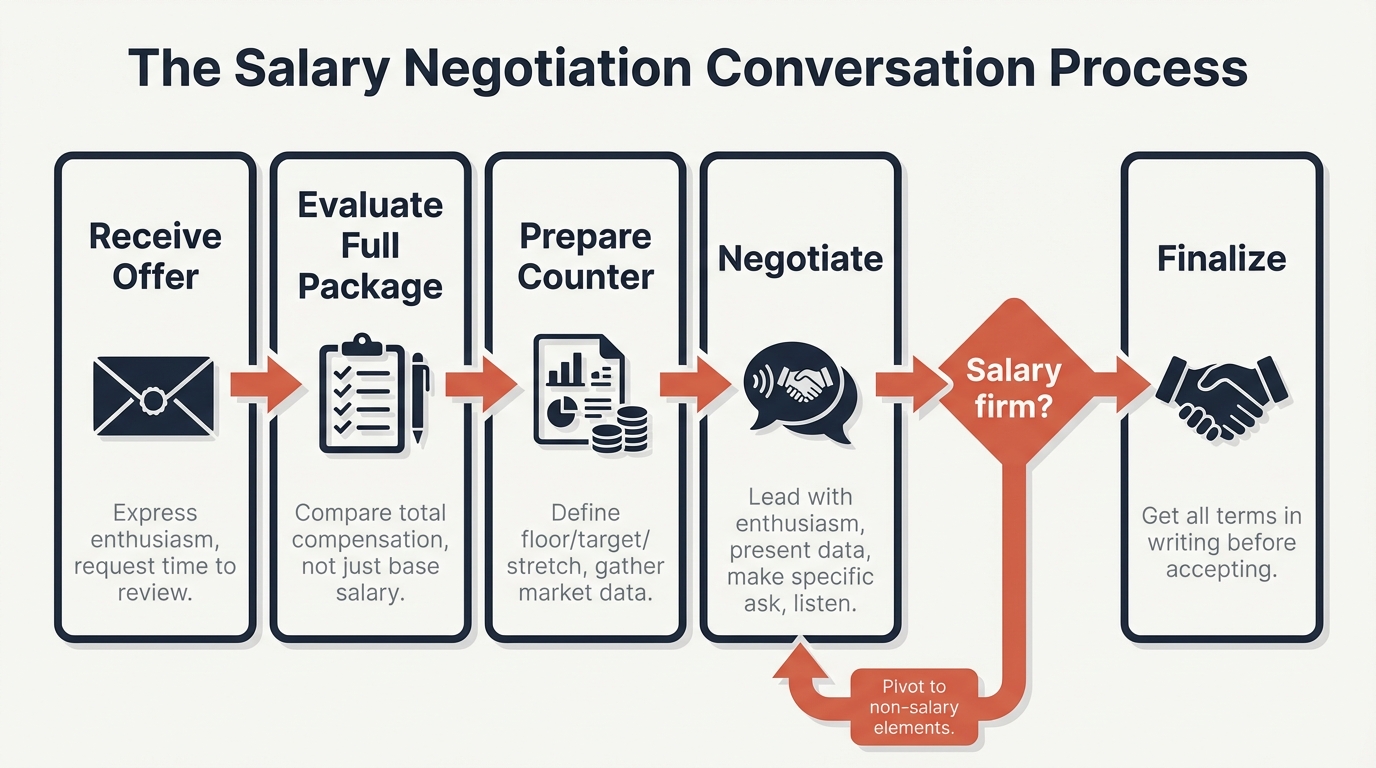
After the offer is extended. This is where the primary negotiation occurs. The employer has decided you are their preferred candidate. You have maximum leverage. Take the offer details, express enthusiasm, and ask for time to review: "Thank you. I'm excited about this opportunity. I'd like a few days to review the full offer and get back to you." Most employers grant 3-5 business days, and many will extend beyond that if you ask professionally.
Responding to an Initial Offer
When you receive an offer, your first response should never be immediate acceptance or rejection. Even if the number exceeds your target, take the offer in writing, review the full package (Section 11.3), and respond within the agreed timeframe.
If the offer is below your target, a counteroffer conversation follows a predictable structure:
-
Lead with enthusiasm. Reaffirm your interest in the role and the organization. The employer needs to know that you want the job; the conversation is about finding the right compensation, not about whether you will accept at all.
-
Present your rationale. This is where your preparation pays off. Reference the market data you collected: "Based on my research using BLS data, CyberSeek, and the Robert Half Salary Guide, the market range for a SOC Analyst I in this region with my qualifications is $54,000 to $62,000. Given my Security+ certification and my practicum experience in a SOC environment, I believe a salary of $58,000 better reflects the value I bring to this role."
-
Make a specific ask. Vague requests ("Can you do better?") produce vague results. Propose a specific number with a specific justification. Specificity signals that you have done your homework and that your ask is grounded in evidence, not wishful thinking.
-
Listen. The employer will respond. They may meet your number, counter with something between their initial offer and your ask, explain constraints that limit their flexibility, or offer to improve other elements of the package. Each of these responses opens a path forward.
Handling Common Scenarios
"That's the best we can do on salary." This may be true (especially in government or pay-banded organizations) or it may be a negotiation tactic. Either way, your response is the same: pivot to other elements of the package. "I understand the salary constraints. Would there be flexibility on the signing bonus, professional development budget, or remote work schedule?" Section 11.6 covers this in detail.
"What are you currently making?" In states with salary history bans, this question is illegal. In other states, you are still not obligated to answer. Redirect: "I'd prefer to focus on the market value for this role and the qualifications I bring. Based on my research, the appropriate range is $X to $Y."
"We need an answer by Friday." Artificial deadlines are a pressure tactic. Most employers will extend a deadline if you ask politely: "I want to make a thoughtful decision, and I'd appreciate a few additional days. Would next Tuesday work?" If they refuse to extend, consider what that rigidity signals about the organization's culture.
"We have other candidates." This may be true, but if they extended the offer to you, you are their preferred candidate. Other candidates are a negotiation lever, not a reason to abandon your position. Respond with confidence: "I appreciate that, and I'm very interested in this role. I want to make sure the compensation reflects the value I'll bring, so I can fully commit."
Analyst Perspective
Practice your negotiation conversation out loud before the real thing. Say the words. Hearing yourself articulate your value proposition and your specific ask builds confidence and reveals weak spots in your reasoning. Practice with a friend, a mentor, or a career services advisor. The first time you say "I'm targeting $58,000 based on market data" should not be in the actual conversation.
11.6 Negotiating Beyond Salary
In some employment contexts, the base salary is genuinely non-negotiable. Federal government positions pay according to the GS scale. Many state and local government roles have fixed pay bands. Some contract positions have rates dictated by the prime contractor's agreement with the client agency. When the salary number is locked, negotiation shifts to every other element of the package, and there is more room here than most candidates realize.
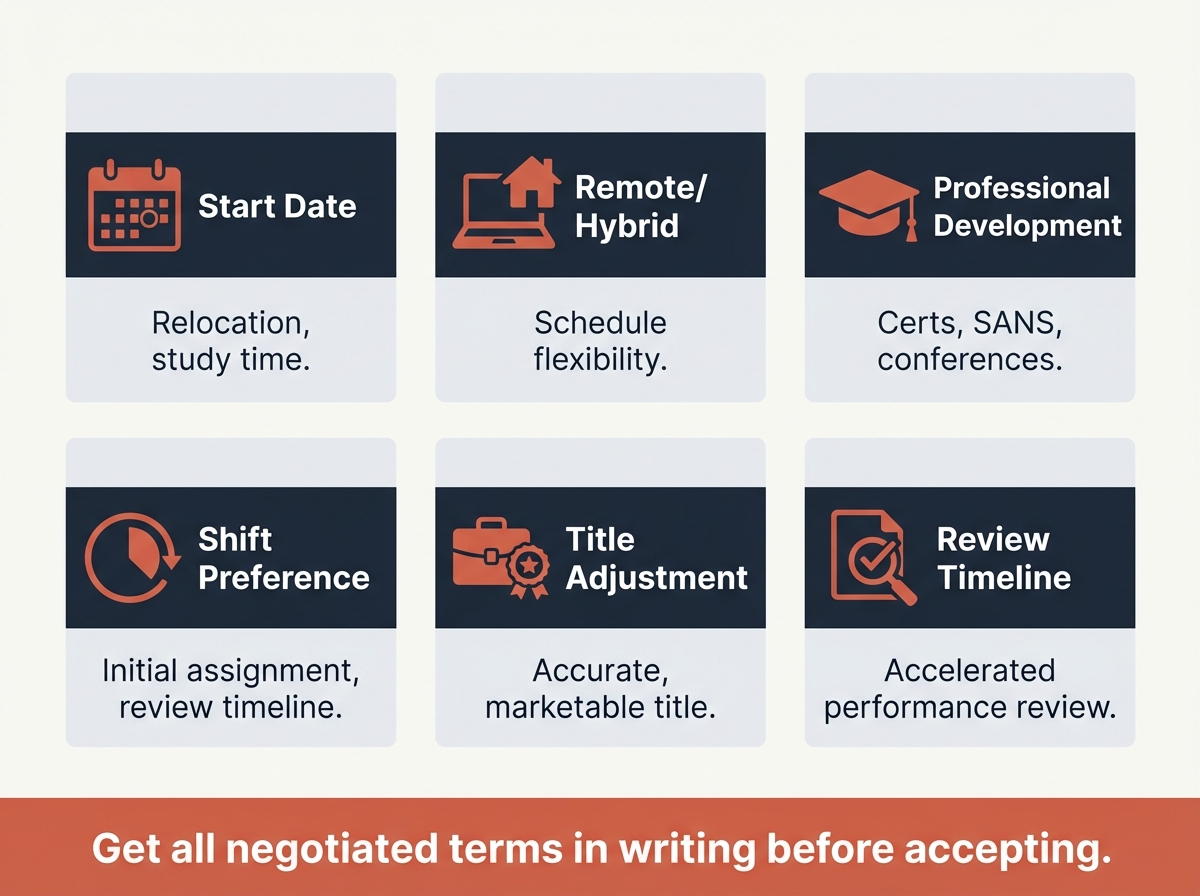
Elements You Can Negotiate
Start date. If you need time between positions for relocation, certification study, or personal obligations, requesting a later start date costs the employer nothing beyond a few weeks of vacancy.
Remote or hybrid schedule. Many cybersecurity roles can be performed remotely, and employers increasingly offer flexibility as a recruitment tool. If the offer specifies five days on-site, asking for a hybrid arrangement (e.g., three days on-site, two remote) is a reasonable request, particularly if the role involves work that does not require physical presence in a SOC.
Professional development budget. Ask the employer to fund specific certifications, training courses, or conference attendance. Be specific: "Would the team support funding my CySA+ exam and one SANS course during my first year?" A specific ask is easier for a manager to approve than a vague request for "professional development."
Certification exam fees and study time. Some employers cover the exam fee but not study time; others provide both. If certification is a priority for the role, negotiate study time as part of your onboarding plan.
Shift preference. In SOC environments with rotating shifts, negotiating your initial shift assignment or the timeline for a shift preference review can significantly affect your quality of life (as Chapter 10 discussed in detail).
Title adjustment. Titles affect your future marketability. If the employer titles the role "IT Support Specialist" but the duties align with "Junior SOC Analyst," negotiating for a more accurate title costs the employer nothing and benefits your resume and LinkedIn profile.
Review timeline. Some employers conduct annual performance reviews; others do them at 18-month intervals. Negotiating a six-month review with the possibility of an early raise or promotion accelerates your trajectory within the organization.
Relocation assistance. If the position requires relocating, ask about relocation packages. These may include moving expense reimbursement, temporary housing, or a lump-sum relocation bonus.
Warning
Get any negotiated terms in writing before you accept the offer. Verbal commitments made during a negotiation are difficult to enforce, especially if the hiring manager changes roles or leaves the organization. Ask for an updated offer letter that reflects all agreed-upon terms, or at minimum, request an email confirming the specifics.
11.7 Common Mistakes and Ethical Considerations
Negotiation is a professional skill, and like any skill, there are common failure modes. Being aware of these mistakes before your first negotiation helps you avoid them.
Common Mistakes
Accepting immediately out of anxiety. The relief of receiving an offer is powerful, especially after a long job search. That emotional spike is exactly why you should not accept on the spot. Take the time you are given to review the full package, compare it against your research, and make a deliberate decision.
Negotiating without data. Saying "I want more" without a rationale puts the employer in a difficult position and makes you look unprepared. Every ask should be tied to market data, your qualifications, or both. The preparation framework in Section 11.4 exists for this reason.
Focusing exclusively on base salary. As Section 11.3 demonstrated, total compensation often tells a very different story than base salary alone. A candidate who fixates on the salary number and ignores a weak retirement match or zero professional development support is leaving value unexamined.
Comparing to peers. "My friend got $60,000 at Company X" is not a negotiation argument. Your friend's offer was based on their qualifications, the company's budget, and the specific role. Your negotiation should be based on the market data for your role, your qualifications, and the value you bring to this employer.
Burning bridges. The cybersecurity community is smaller than it appears. The recruiter you alienate today may be the hiring manager for your next opportunity. Conduct every negotiation with professionalism, even when the outcome is not what you hoped. If you decline an offer, do so graciously and leave the door open.
Ethical Negotiation
Professional negotiation operates on a foundation of honesty. There are several ethical boundaries that should not be crossed:
Do not fabricate competing offers. Claiming to have an offer you do not have is dishonest and risks catastrophic damage to your professional reputation if discovered. If you have a competing offer, reference it factually. If you do not, negotiate based on market data and your qualifications.
Do not misrepresent your qualifications. If you list a certification on your resume that you have not yet earned, do not reference it as a justification for higher pay. Misrepresentation in a negotiation is a form of fraud that can result in offer rescission or termination.
Do not negotiate in bad faith. If you have already decided to accept another offer, do not use this employer's negotiation process as leverage to extract a better counter from the preferred employer. This wastes the employer's time and damages trust across the industry.
Do not accept and renege. Once you have formally accepted an offer, reneging to take a different position is a serious breach of professional conduct. It burns a bridge permanently and, in a field as interconnected as cybersecurity, can follow your reputation.
Analyst Perspective
Ethical negotiation is not just a moral principle. It is a career strategy. The cybersecurity and digital forensics community relies heavily on professional networks, referrals, and reputation. Analysts who negotiate with integrity build a reputation that opens doors throughout their careers. Analysts who cut corners in negotiation eventually run out of doors to open.
11.8 Salary Negotiation Quick-Reference Framework
Use this table as a step-by-step checklist when preparing for any compensation discussion.
| Phase | Action | Key Questions |
|---|---|---|
| Research | Pull compensation data from 3+ sources | What is the market range for this specific role, location, and experience level? |
| Research | Check salary transparency and history laws in applicable state(s) | Is the employer required to disclose the pay range? Can they ask my salary history? |
| Evaluate | Request and review the full compensation package | What is the total compensation value beyond base salary? |
| Prepare | Define your floor, target, and stretch numbers | What is the lowest I would accept? What am I aiming for? What is the best realistic outcome? |
| Prepare | Document your value proposition | What specific qualifications, certifications, and experience support my ask? |
| Prepare | Understand employer constraints | Is this a pay-banded role? What fiscal cycle is the organization on? |
| Negotiate | Respond to the offer with enthusiasm and a specific, data-backed counteroffer | Can I articulate why my target number is justified using market data and my qualifications? |
| Negotiate | If salary is firm, pivot to non-salary elements | What other elements of the package (signing bonus, remote work, prof. dev., title, review timeline) have flexibility? |
| Finalize | Get all negotiated terms in writing before accepting | Does the updated offer letter or confirmation email reflect every term we agreed on? |
| Finalize | Accept or decline professionally | Have I communicated my decision graciously, regardless of the outcome? |
Chapter Summary
-
Negotiation is expected and professional. Employers build room into their initial offers, and the compounding effect of your starting salary makes negotiation one of the highest-value career skills you can develop. Failing to negotiate your first salary can cost hundreds of thousands of dollars over a career.
-
Market research is the foundation. Use at least three reputable compensation data sources (BLS, CyberSeek, Glassdoor, ISACA reports, and others) to triangulate the market range for your specific role, geography, and qualifications. No single source is sufficient on its own.
-
Total compensation matters more than base salary. Evaluate every component of an offer: retirement matching, health insurance, signing and performance bonuses, professional development support, remote flexibility, and PTO. Two offers with identical base salaries can differ by tens of thousands of dollars in total value.
-
Preparation determines outcomes. Define your floor, target, and stretch numbers before any salary conversation. Document your value proposition with specific evidence. Understand the employer's constraints so your asks are realistic.
-
The conversation follows a predictable structure. Lead with enthusiasm, present data-backed rationale, make a specific ask, and listen. When salary is fixed, pivot to non-salary elements where flexibility often exists.
-
Ethical negotiation is a career strategy. Do not fabricate offers, misrepresent qualifications, or negotiate in bad faith. The cybersecurity community is small, and your professional reputation is a long-term asset.
-
Looking ahead: The skills covered in this chapter apply to every career transition, not just your first job. As you progress from entry-level roles to senior positions, the stakes of each negotiation increase. The framework remains the same: research, prepare, communicate, and always negotiate with integrity.