CH2: Threat Landscape: Actors, Motivations, and Threat Intelligence
Introduction
Understanding the threat landscape is the foundation of effective security strategy. The modern threat environment is not a monolithic challenge but rather a complex ecosystem of actors with distinct capabilities, motivations, and operating styles. Whether you are designing defenses, investigating incidents, or advising business leaders, you must be able to identify who is targeting your organization, what they want, and how they operate.
This chapter examines three interconnected domains: the intelligence that enables threat awareness, the scoring systems that help prioritize vulnerabilities, and the diverse actors who exploit those vulnerabilities. By the end of this chapter, you will understand how threats are characterized, how to obtain actionable threat intelligence, and how to distinguish between threat actors based on their capabilities and intentions.
Learning Objectives
After completing this chapter, you will be able to:
- Define threat characteristics and explain the difference between threats, vulnerabilities, and risks.
- Identify sources of threat intelligence and interpret threat feeds, indicators of compromise, and tactical threat data.
- Explain the Common Vulnerability Scoring System (CVSS) framework and apply severity ratings to prioritization decisions.
- Categorize threat actors by type, capability, and motivation, and explain how internal positioning affects threat severity.
- Analyze attack scenarios to determine actor type and likely motivation based on observable characteristics.
2.1 Understanding Threats and Threat Intelligence
What Is a Threat?
A threat is any event, action, or circumstance that could cause harm to information systems or organizational assets. Threats are distinct from vulnerabilities and risks:
- A vulnerability is a weakness in hardware, software, or policy that can be exploited.
- A threat is a potential agent or event that could exploit that vulnerability.
- A risk is the probability and impact of a threat exploiting a vulnerability.
Example: A server with outdated TLS support (vulnerability) has no risk if no attacker (threat) targets it. An attacker developing exploits for that TLS weakness (threat agent) creates actual risk.
Threat characteristics include:
- Source: Internal or external; known or unknown.
- Vector: The path or method used to deliver the threat.
- Intent: Accidental or intentional; ranging from curiosity to destructive malice.
- Capability: The technical sophistication and resources available to the threat actor.
- Probability: How likely the threat is to occur against your organization.
Figure 2.1 connects the threat, the exploitable weakness, and the potential harm to a risk assessment.
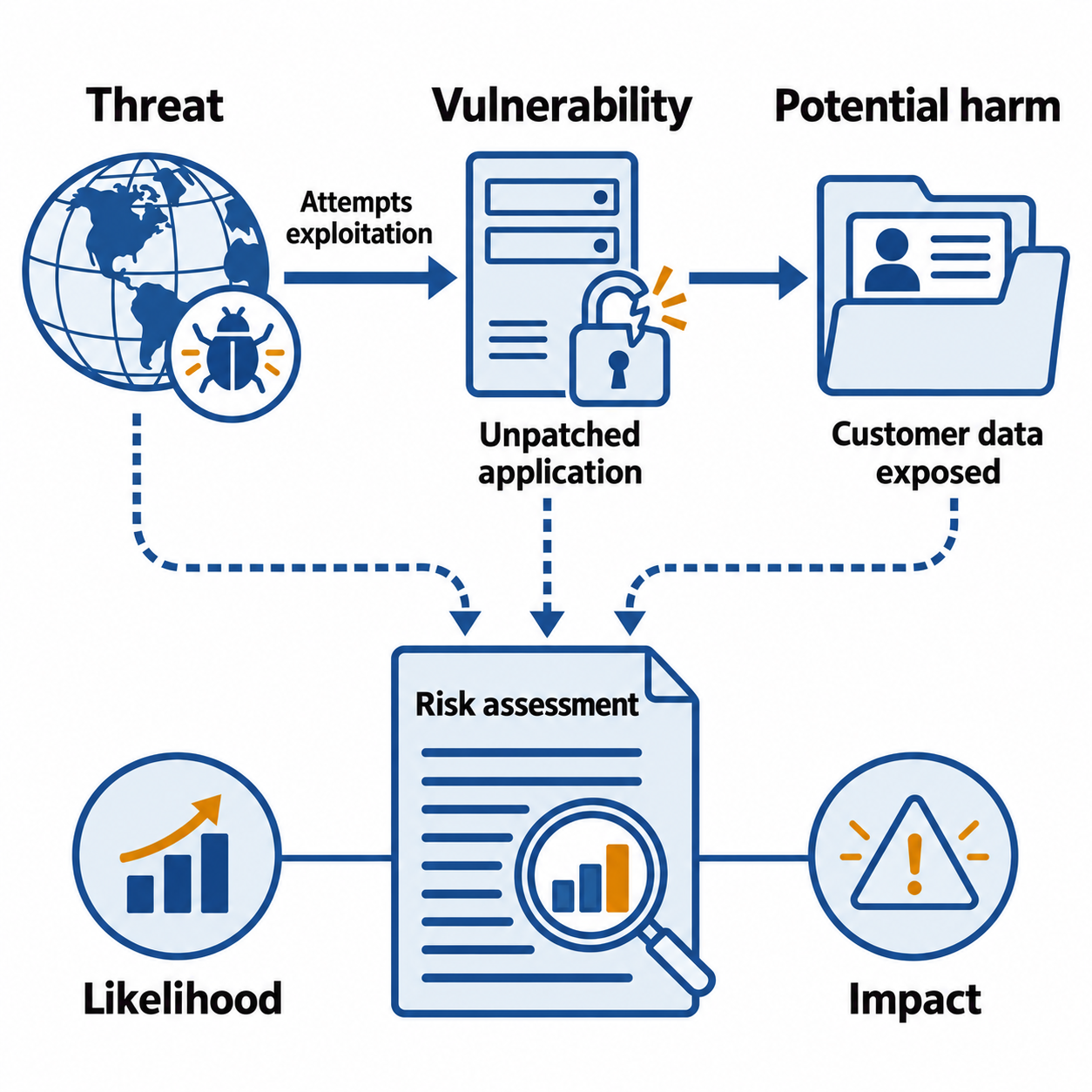
Figure 2.1: An exploitable weakness creates a path to harm. Risk assessment considers how likely that path is and the consequences for the organization.
Text description for Figure 2.1
A threat attempts to exploit a vulnerability in an unpatched application. Successful exploitation could expose customer data. Risk assessment considers the likelihood of that scenario and its impact, including exposure, existing controls, and the value of affected information. An organization can face risk before it observes an attacker targeting the system.
Threat Intelligence Fundamentals
Threat intelligence (TI) is data, analysis, and context that inform decisions about threats to the organization. Effective TI answers four key questions:
- Who is attacking?
- What are they targeting?
- How are they attacking?
- Why are they attacking?
Threat intelligence is collected, analyzed, and shared through a variety of sources and mechanisms. The maturity of your TI program determines how quickly your organization can detect, respond to, and prevent attacks.
Sources of Threat Intelligence
Threat intelligence originates from multiple channels. Understanding each source's strengths and limitations is critical for building a robust intelligence picture.
Open-Source Intelligence (OSINT)
Open-Source Intelligence refers to intelligence gathered from publicly available information. OSINT sources include:
- News articles, security blogs, and research publications.
- Social media and public forums where threat actors discuss tools and techniques.
- Domain registries, SSL certificate transparency logs, and DNS records.
- GitHub repositories and code hosting platforms where adversaries sometimes leak tools.
- Job postings, conference talks, and leaked corporate documents.
OSINT is cost-effective and legally straightforward but requires careful validation. False leads, misleading information, and disinformation are common. Security researchers and threat analysts must apply critical thinking to distinguish signal from noise.
Threat Feeds and Commercial Intelligence
Commercial threat feeds are curated, often real-time data sources provided by security vendors. These feeds typically include:
- Indicators of Compromise (IoCs): File hashes, IP addresses, domain names, and URLs associated with known malware or threat actors.
- Malware signatures: Detection rules and behavioral patterns.
- Threat actor profiles: Analysis of tactics, techniques, and procedures (TTPs).
- Vulnerability disclosures: Emerging CVEs with contextual analysis.
Commercial feeds are more reliable and timely than OSINT alone, but they come at cost and may be available only to subscribers. Vendors curate intelligence based on their visibility into threat traffic, which is inherently limited to their customer base and their own research.
Information Sharing and Analysis Centers (ISACs)
Information Sharing and Analysis Centers are sector-specific organizations where organizations share threat intelligence with peers. Major ISACs include:
- FS-ISAC (Financial Services): Banking, insurance, capital markets.
- Health-ISAC (Healthcare): Hospitals and health systems.
- E-ISAC (Energy): Electric utilities and power systems.
- NH-ISAC (Higher Education and Research): Universities and research institutions.
ISACs provide trusted channels for intelligence sharing without requiring public disclosure. Organizations report indicators and incidents to ISAC analysts, who aggregate the data, remove sensitive details, and redistribute sanitized intelligence to all members. ISACs also coordinate incident response and provide sector-specific threat briefings.
Government Sources
Government cybersecurity agencies publish threat intelligence for public consumption:
- CISA (Cybersecurity and Infrastructure Security Agency): The United States federal agency maintains a public repository of CVEs, publishes alerts and advisories, and coordinates incident response.
- NSA Cybersecurity Collaboration Center: Publishes hardening guidance and threat advisories.
- NCSC (National Cyber Security Centre, UK): Similar advisory and threat intelligence role for the United Kingdom.
- Cert-CC (Computer Emergency Response Team): Carnegie Mellon's federally funded research center, now part of CISA's coordination efforts.
Government intelligence is authoritative, freely available, and often based on classified analysis that cannot be shared with the public. However, the classification requirement creates a lag in disclosure.
Figure 2.2 shows how analysts combine complementary intelligence sources.
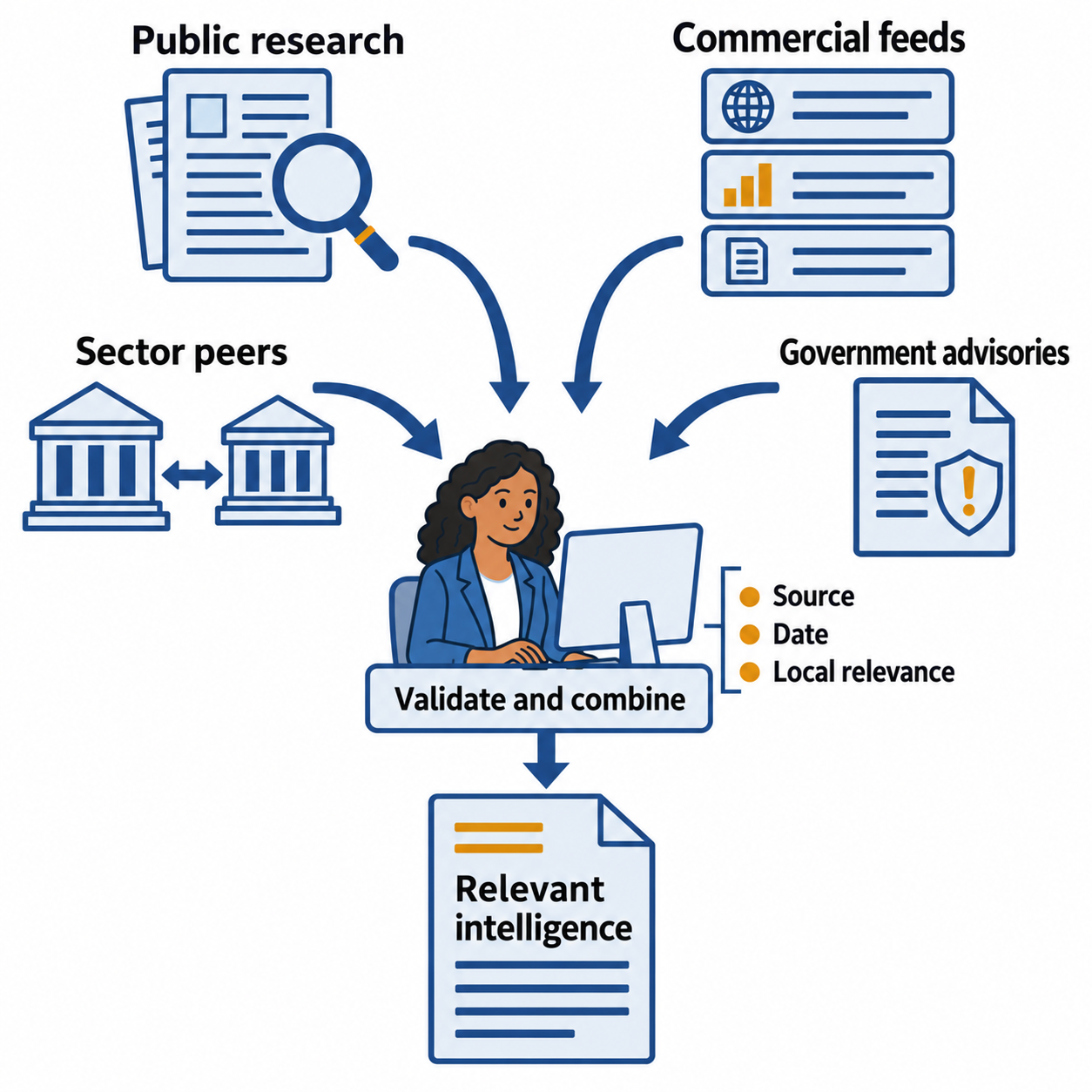
Figure 2.2: Public research, commercial feeds, sector peers, and government advisories contribute different observations that analysts validate and combine.
Text description for Figure 2.2
Public research, commercial feeds, sector peers, and government advisories provide observations with different coverage and limitations. Analysts examine the source, observation date, and relevance to local systems, then combine corroborating information. A source category alone does not establish accuracy or timeliness. An indicator feed is a delivery mechanism that several source types can use.
Indicator of Compromise (IoC) Feeds
An Indicator of Compromise is a piece of data that suggests a system has been breached. IoCs include:
- File hashes (MD5, SHA-1, SHA-256): Identifying malware samples or suspicious files.
- IP addresses: Attacker command-and-control servers, staging infrastructure, or VPN endpoints.
- Domain names: Malicious domains used in phishing campaigns or malware callbacks.
- URLs: Specific paths to malicious payloads or command infrastructure.
- Email headers: SMTP servers, authentication failures, or unusual routing patterns.
- Registry keys or file paths: Artifacts left by malware on Windows systems.
- Process names or command-line arguments: Behavioral signatures of known attacks.
IoC feeds can be consumed manually by analysts or ingested automatically into Security Information and Event Management (SIEM) systems for real-time alerting.
Analyst Perspective
Not all indicators are equally valuable. A hash of a well-known malware sample is highly specific but may only match active intrusions if your environment uses that exact variant. A suspicious domain name is broader and may match future campaigns by the same actor. Prioritize indicators based on your threat model and your organization's technical maturity to handle alert volume.
Figure 2.3 traces the checks that turn an indicator match into a supported assessment.
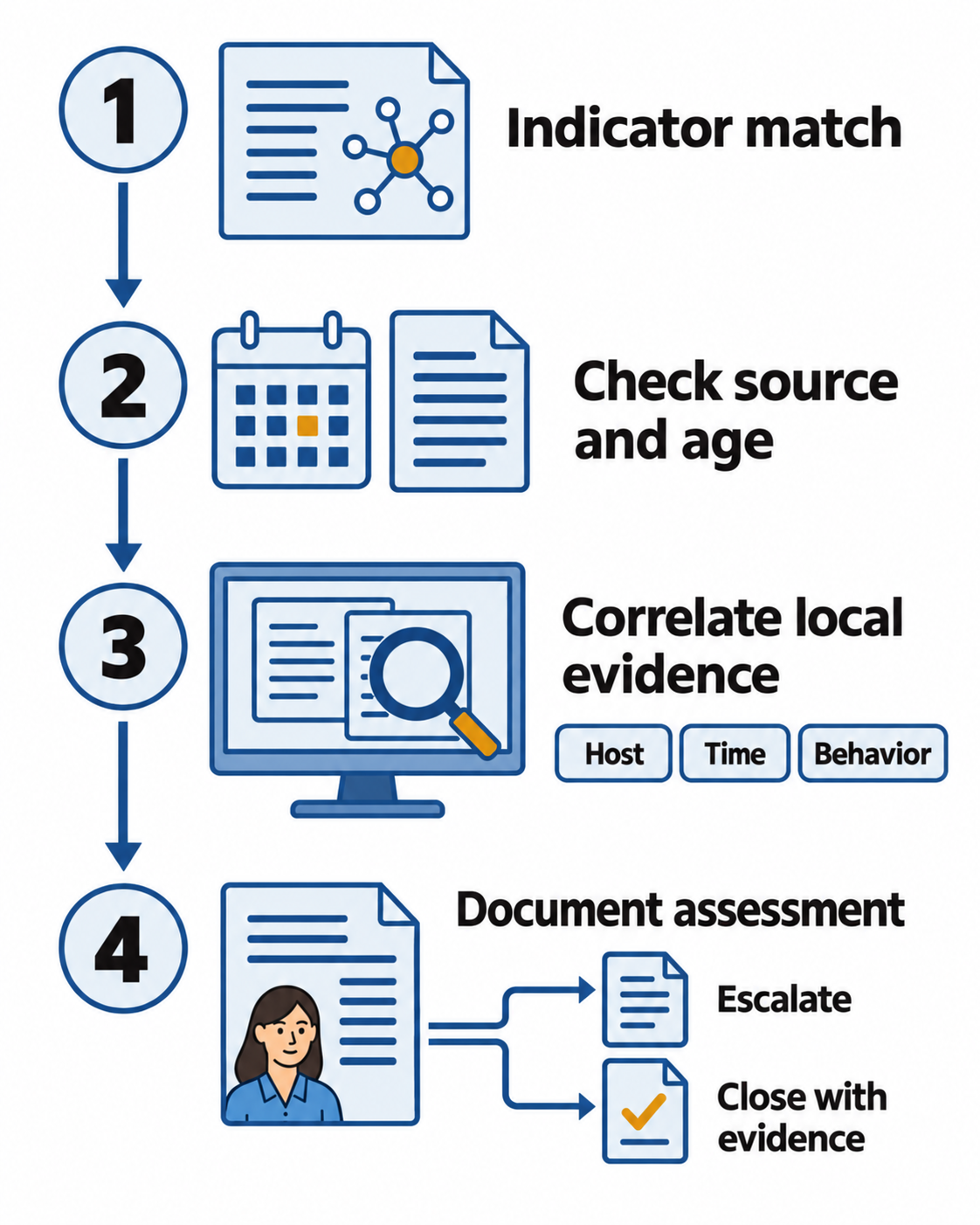
Figure 2.3: An indicator of compromise (IoC) match starts an investigation. Source quality, age, and related activity determine its evidentiary value.
Text description for Figure 2.3
First identify the indicator that matched. Check who reported it and when the associated behavior occurred. Correlate the match with the affected host, event time, and related behavior. Document whether the combined evidence supports escalation or a supported closure. Stale infrastructure records, shared services, and incomplete local evidence can change the interpretation.
Putting It Together: Building a Threat Intelligence Process
A security team for a mid-sized financial services company receives a report from FS-ISAC about a new ransomware variant targeting banks. The intelligence includes:
- Hashes of the ransomware executable and encrypted documents.
- C2 (command-and-control) domain names and IP addresses.
- A description of the initial access vector: spear-phishing with malicious attachments.
- Indicators of compromise: file paths, registry keys, and network traffic patterns.
The team takes the following actions:
- Immediate: Add the IoCs to the SIEM and endpoint protection system to detect any matching activity. Alert the SOC (Security Operations Center) to monitor for hits.
- Short-term: Conduct threat hunting using the behavioral indicators to search for evidence of similar activity not yet detected by automated tools.
- Medium-term: Develop a communication about the threat for distribution to business units, emphasizing the phishing vector and requesting heightened vigilance.
- Strategic: Analyze the threat actor's capabilities and motivations (financial, likely) to inform risk assessments and insurance discussions.
This multi-layered approach transforms raw intelligence into actionable defensive measures.
Figure 2.4 maps the report in this teaching scenario to four defensive uses.
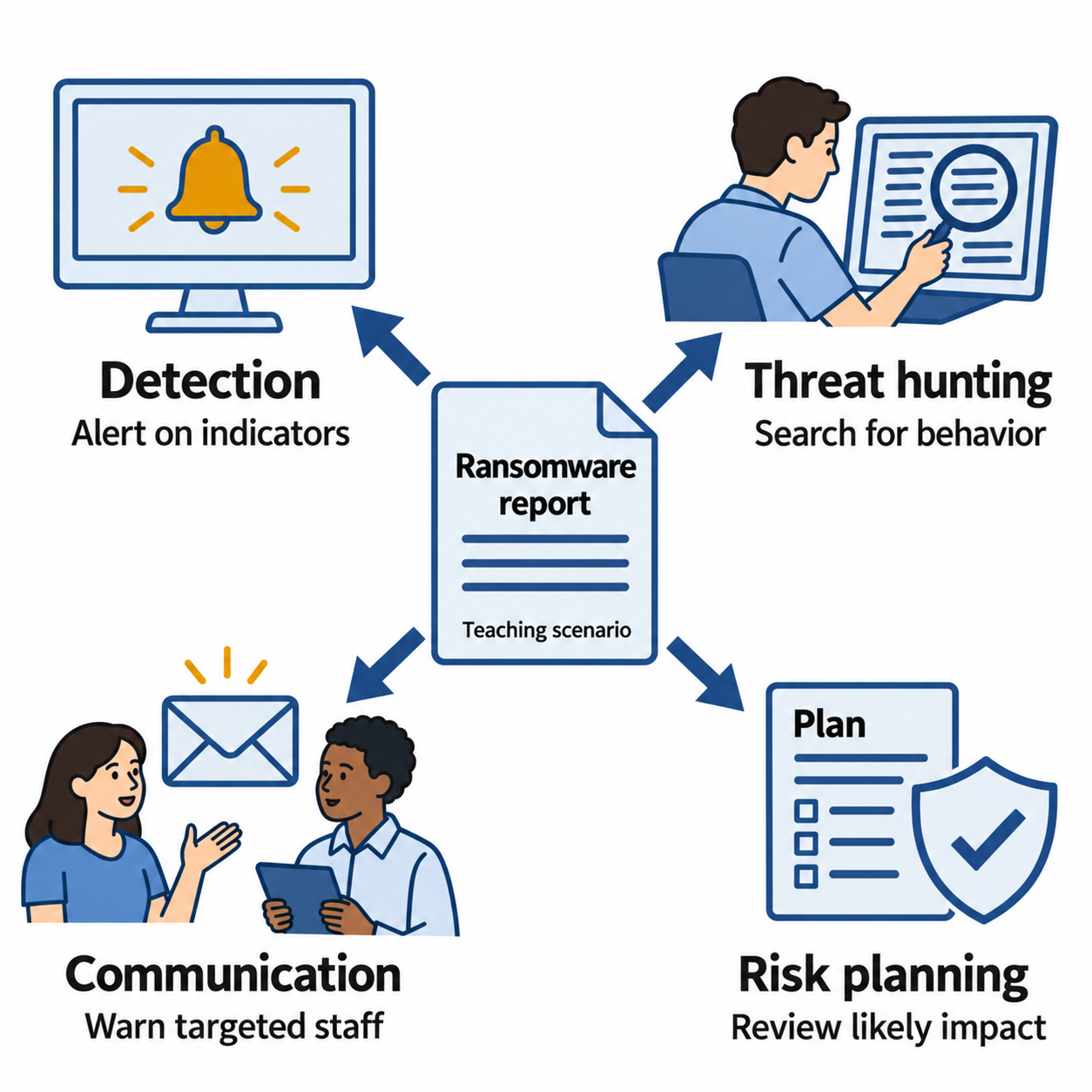
Figure 2.4: The financial-services scenario uses one ransomware report to support detection, threat hunting, staff communication, and risk planning.
Text description for Figure 2.4
The financial-services team uses the report in four ways. Detection rules look for supplied indicators. Threat hunting searches for related behavior that automated rules may miss. Staff communication explains the targeting and phishing method. Risk planning considers the actor's likely goals and potential business impact. The branches can proceed together as the team evaluates new evidence.
2.2 Vulnerability Characteristics and Scoring
What Is a Vulnerability?
A vulnerability is a weakness in hardware, software, network design, or operational procedures that can be exploited to compromise the confidentiality, integrity, or availability of information or systems. Vulnerabilities include:
- Design flaws: Logical weaknesses in protocols or architectures (e.g., TLS versions with known ciphers).
- Implementation bugs: Coding errors that create unintended behaviors (e.g., buffer overflows).
- Configuration errors: Systems deployed with weak or default settings (e.g., admin accounts with default passwords).
- Policy gaps: Absence of controls or procedures (e.g., no password expiration policy).
Vulnerabilities exist in every system; the goal is not elimination but identification and prioritization.
The Common Vulnerability Scoring System (CVSS)
The Common Vulnerability Scoring System provides a standardized method for scoring and communicating the severity of vulnerabilities. CVSS is maintained by FIRST (Forum of Incident Response and Security Teams) and is the industry standard for vulnerability assessment.
CVSS scores range from 0.0 (no vulnerability) to 10.0 (maximum severity). A vulnerability with a CVSS score of 10.0 is exploitable remotely with no authentication and affects confidentiality, integrity, and availability.
CVSS Scoring Components
CVSS v3.1 (the current standard) uses three metric groups:
Base Score Metrics (static; do not change over time):
- Attack Vector (AV): Network (remote, no access to system required), Adjacent (same network segment), Local (authorized or interactive access), Physical (device manipulation).
- Attack Complexity (AC): Low (attacker requires no special conditions) or High (specific configurations or race conditions required).
- Privileges Required (PR): None, Low (standard user), or High (administrator).
- User Interaction (UI): None (automatic exploitation) or Required (victim must perform an action).
- Scope (S): Unchanged (impact limited to vulnerable component) or Changed (impact extends to other systems or components).
- Confidentiality (C), Integrity (I), Availability (A): None, Low, or High impact on each triad.
A base score is calculated from these six metrics using a mathematical formula.
Temporal Score Metrics (change over time):
- Exploit Code Maturity: Unproven, Proof-of-Concept, Functional, or High (weaponized, widely used).
- Remediation Level: Unavailable, Workaround, Temporary Fix, or Official Fix.
- Report Confidence: Unknown, Reasonable, or Confirmed.
These metrics adjust the base score to reflect the operational context of the vulnerability.
Environmental Score Metrics (specific to your organization):
- Modified Base Metrics: Adjusted versions of the base metrics if your environment's conditions differ (e.g., the vulnerability requires local access but your systems enforce remote-only administration, reducing the threat).
- Confidentiality/Integrity/Availability Requirement: How critical is each triad for your organization? Adjusting these reflects business impact.
Organizations may apply environmental metrics to reflect their specific risk tolerance and system criticality.
Figure 2.5 identifies the roles of the metric groups in the v3.1 model discussed here.
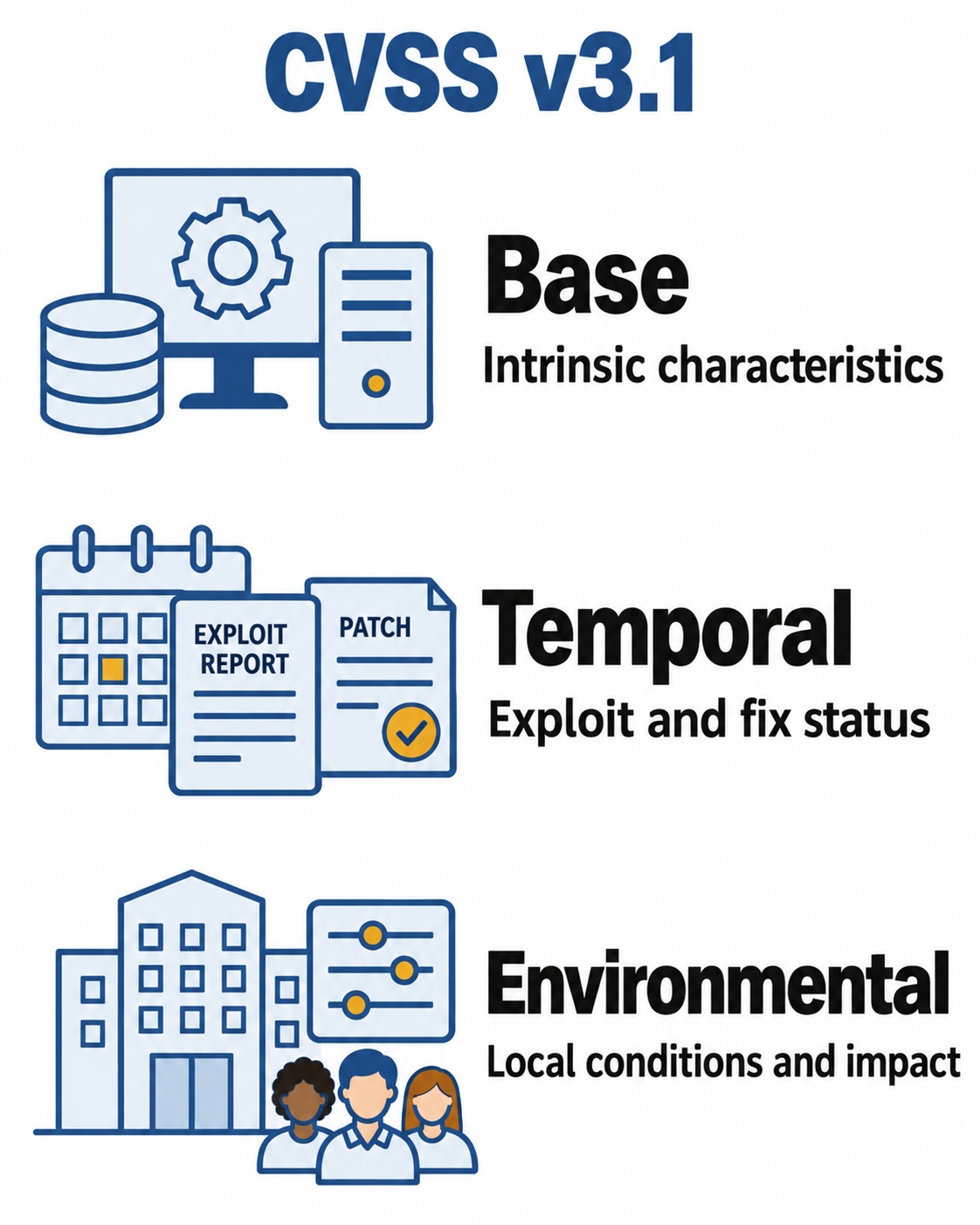
Figure 2.5: The Common Vulnerability Scoring System (CVSS) v3.1 uses Base, Temporal, and Environmental metric groups to express vulnerability severity.
Text description for Figure 2.5
The Base group describes intrinsic vulnerability characteristics. Temporal metrics reflect changing exploit maturity, remediation availability, and report confidence. Environmental metrics reflect local conditions and security requirements. This figure deliberately uses v3.1 terminology to match the chapter's detailed metric discussion. FIRST also publishes v4.0, whose metric groups differ. Record the version with any score.
CVSS Severity Ratings
CVSS scores are grouped into severity ratings:
| CVSS Score | Severity |
|---|---|
| 0.0 | None |
| 0.1–3.9 | Low |
| 4.0–6.9 | Medium |
| 7.0–8.9 | High |
| 9.0–10.0 | Critical |
A vulnerability with a CVSS score of 7.0 or higher typically triggers rapid patching decisions and higher priority in vulnerability management workflows.
CVE and NVD
The Common Vulnerabilities and Exposures (CVE) system is a standardized naming scheme for publicly known vulnerabilities. Each CVE receives a unique identifier: CVE-YYYY-NNNNN (e.g., CVE-2024-1234 refers to a vulnerability published in 2024).
The National Vulnerability Database (NVD), maintained by NIST, indexes all published CVEs, provides CVSS scores, references to patches, and detailed technical descriptions. The NVD is the authoritative source for CVSS scoring in the absence of vendor-provided scores.
Warning
CVE IDs are assigned to publicly disclosed vulnerabilities only. Unpatched vulnerabilities known to a small number of organizations or vendors (0-days) do not yet have CVE IDs. Once disclosed, a 0-day receives a CVE ID, and CISA or vendor advisories guide remediation.
Figure 2.6 separates vulnerability identification, severity assessment, and database enrichment.
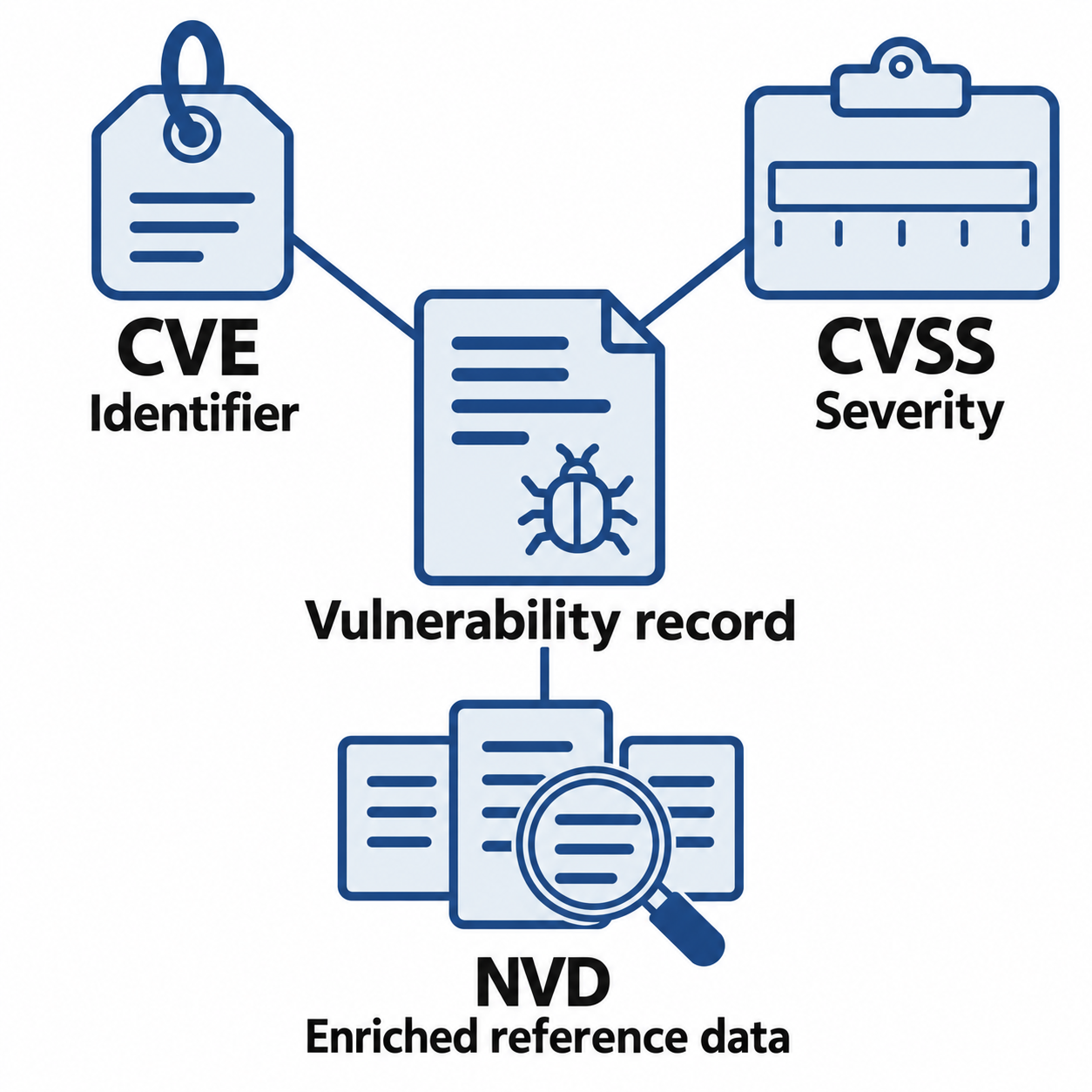
Figure 2.6: Common Vulnerabilities and Exposures (CVE) supplies identifiers, CVSS describes severity, and the National Vulnerability Database (NVD) adds reference and analysis data.
Text description for Figure 2.6
A CVE identifier lets organizations refer to the same vulnerability. CVSS expresses assessed technical severity using a specified version and metric values. NVD enriches published CVE records with analysis and reference data as available. These roles support communication and investigation. A record may have incomplete or pending analysis, and a CVE identifier alone does not establish exploitation or patch availability.
Vulnerability Types
Understanding vulnerability categories helps with prioritization and defensive strategy:
Execution and Privilege Escalation
Remote Code Execution (RCE) vulnerabilities allow an attacker to run arbitrary code on a target system without prior access. RCE vulnerabilities are among the most dangerous because they often require no authentication.
Privilege Escalation vulnerabilities allow a user with limited permissions to gain higher-level access. Vertical escalation grants administrative rights; horizontal escalation accesses another user's account at the same privilege level.
Information Disclosure
Information Disclosure vulnerabilities expose sensitive data, including PII, credentials, API keys, or technical details about systems. These vulnerabilities may not directly compromise systems but provide attackers with information necessary for secondary attacks.
Authentication and Authorization
Broken Authentication occurs when session management or credential handling is flawed, allowing attackers to impersonate legitimate users.
Broken Access Control allows authenticated users to access resources or perform actions outside their authorization.
Injection and Input Validation
Injection vulnerabilities occur when untrusted input is interpreted as code. SQL injection, command injection, and LDAP injection are common examples. These vulnerabilities often lead to data theft or RCE.
Cross-Site Scripting (XSS) is an injection vulnerability in web applications where an attacker injects malicious JavaScript that executes in the victim's browser.
Cryptographic Weaknesses
Use of Weak Cryptography includes deprecated algorithms (MD5, SHA-1), short key lengths, or improper implementation (hardcoded keys, weak random number generation).
Lack of Encryption occurs when sensitive data is transmitted or stored in plaintext.
Vulnerability Prioritization
Organizations cannot patch every vulnerability immediately. Prioritization frameworks balance urgency, impact, and resource constraints:
- Critical vulnerabilities actively exploited: Patch within days.
- Critical vulnerabilities not yet exploited: Patch within 1-2 weeks.
- High-severity vulnerabilities: Patch within 30 days or mitigate with compensating controls.
- Medium-severity vulnerabilities: Patch within 60-90 days.
- Low-severity vulnerabilities: Address in regular maintenance cycles.
Adjust timelines based on system criticality, exploitability, and your organization's risk tolerance.
Figure 2.7 shows the evidence that supports a remediation priority and target date.
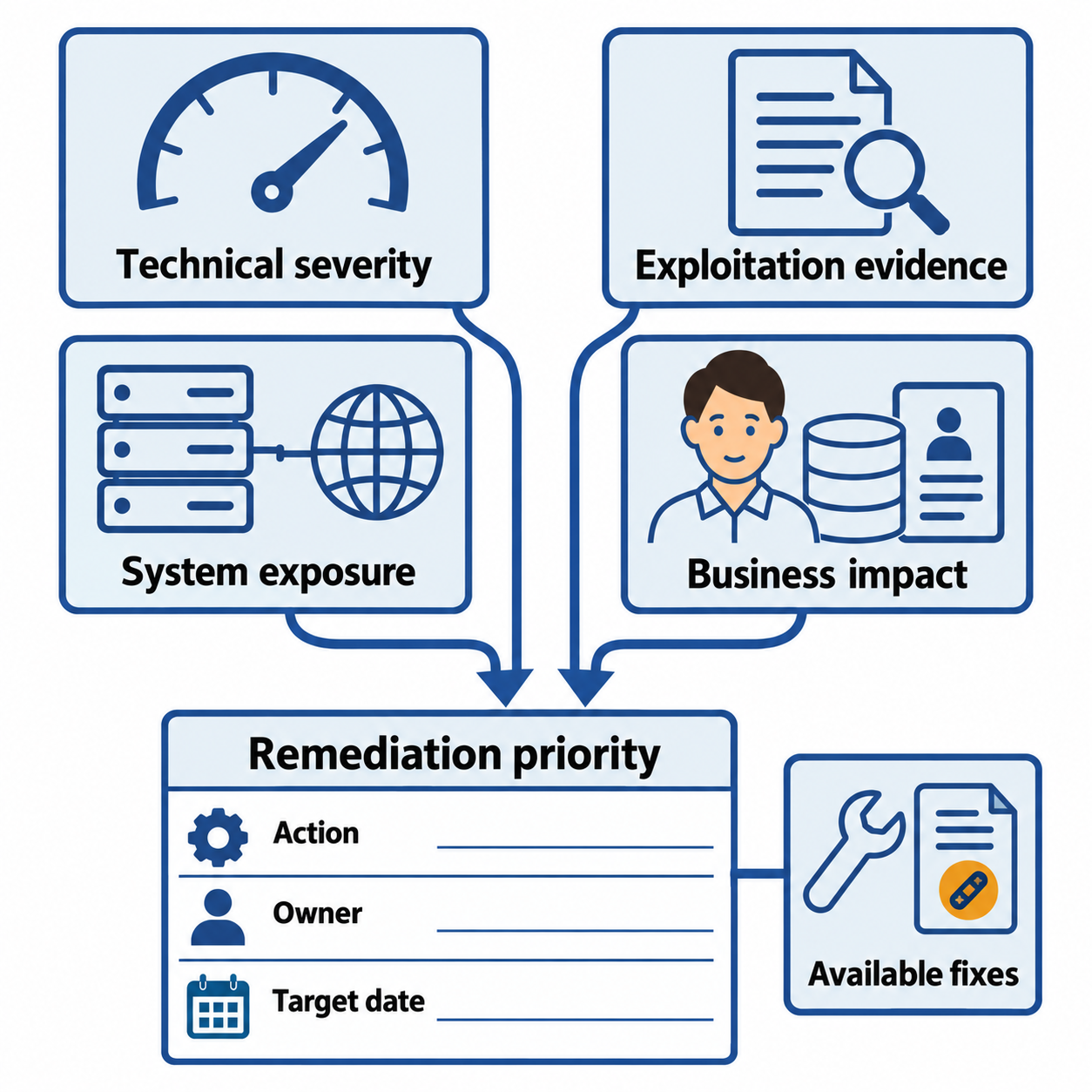
Figure 2.7: Remediation priority combines technical severity with exploitation evidence, exposure, business impact, and available fixes.
Text description for Figure 2.7
Assess technical severity alongside evidence of exploitation, reachability of the affected system, and the consequences for business services or data. Consider available fixes and compensating controls, meaning safeguards that reduce exposure while a permanent fix is prepared. Assign an action, accountable owner, and target date according to organizational policy. Reassess priority when evidence or exposure changes. The chapter's example timelines require local policy context.
Putting It Together: Prioritizing a Vulnerability Disclosure
Your organization runs a web application built with PHP. A vulnerability is disclosed:
- CVE-2024-XXXX: A SQL injection flaw in user search functionality.
- CVSS Score: 8.6 (High).
- Base Metrics: Network attack vector, no authentication required, allows unauthorized data access.
- Exploit Code: Publicly available proof-of-concept code.
- Affected Versions: v3.1 and v3.2; patch available for v3.2, but your organization runs v3.1 which is no longer supported.
Your security team assesses:
- Exploitability: Public PoC and no authentication required = high risk.
- Data Sensitivity: The search function exposes customer PII. Impact is significant.
- Remediation Options: Apply the patch to upgrade to v3.2, or implement Web Application Firewall (WAF) rules to block malicious SQL input while preparing for an upgrade.
Decision: Deploy WAF rules immediately to block known attack patterns. Schedule a full application upgrade within 2 weeks. This balances speed of initial defense with sustainable long-term remediation.
2.3 Threat Actors
Threat actors vary widely in capability, resources, and intent. Understanding these categories helps you anticipate attack types and develop appropriate defensive strategies.
Nation-State Actors and Advanced Persistent Threats (APTs)
Nation-state actors are government-sponsored threat agents with significant resources, including funding, technical expertise, and legal authority. These actors typically pursue strategic objectives: espionage, infrastructure disruption, intellectual property theft, or geopolitical advantage.
Advanced Persistent Threats (APTs) are sophisticated, long-term campaigns often attributed to nation-states. APTs are characterized by:
- Persistence: Maintaining access for months or years.
- Sophistication: Custom malware, zero-day exploits, and advanced techniques.
- Stealth: Avoiding detection through careful operational security.
- Targeted approach: Precision targeting of high-value assets rather than mass exploitation.
APTs target government agencies, defense contractors, critical infrastructure, and large technology companies. Notable examples include operations attributed to Chinese, Russian, Iranian, and North Korean state actors, though attribution is often uncertain and geopolitically charged.
Organized Cybercrime Groups
Organized cybercrime groups operate for financial profit. These actors range from loosely coordinated individuals to hierarchical criminal enterprises with hundreds of members. Their targets include:
- Financial institutions: Direct theft, fraud, wire transfer manipulation.
- Retailers and payment processors: Stealing payment card data for resale.
- All sectors: Ransomware deployment for extortion.
Organized cybercrime groups may be more pragmatic than nation-states; they are less likely to attack customers or partners of organizations that pay protection money or negotiate ransom demands. However, they are also willing to deploy destructive malware if financial incentive exists.
Hacktivists
Hacktivists conduct cyberattacks to promote ideological or social causes. Their methods include website defacement, data theft and public release, and distributed denial-of-service (DDoS) attacks. Hacktivist groups often operate as loose collectives with distributed decision-making.
Motivations vary: environmental activism, anti-racism, anti-war protest, or opposition to government censorship. Hacktivist attacks are typically lower in sophistication than nation-state operations but may be high in public visibility.
Insider Threats
An insider threat is a risk posed by employees, contractors, or business partners with legitimate access to systems and data. Insider threats include:
- Accidental disclosure: An employee mishandles data due to negligence or lack of training.
- Intentional data theft: An employee exfiltrates intellectual property or customer data, often to a competitor or criminal buyer.
- Sabotage: A disgruntled employee deletes systems or damages data.
- Negligent security: An employee fails to follow security policies, creating exposure.
Insider threats are challenging because the attacker already has access, making traditional perimeter defenses ineffective. Detection relies on monitoring user behavior, access logs, and data exfiltration patterns.
Figure 2.8 compares accidental and intentional harm involving legitimate access.
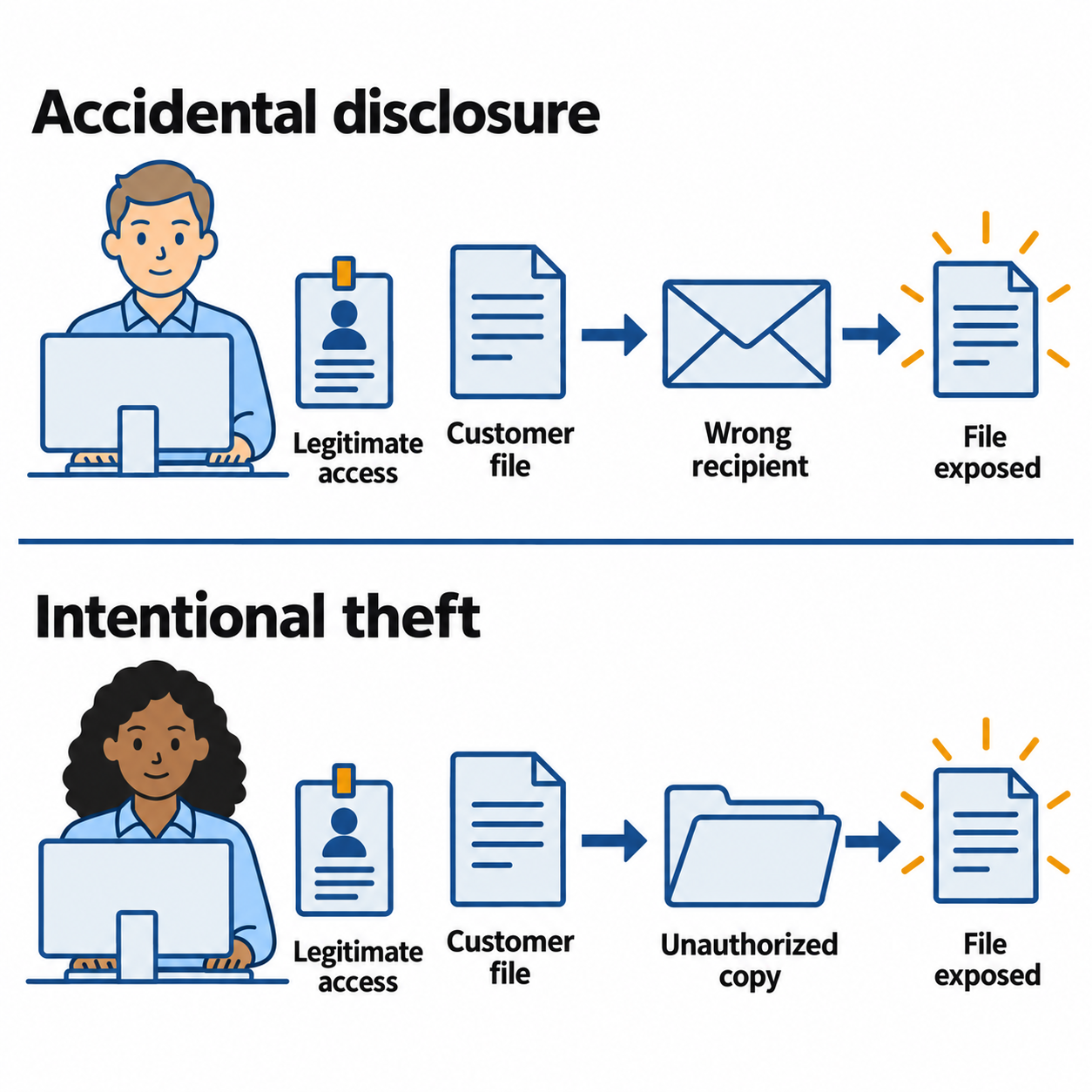
Figure 2.8: Legitimate access can enable accidental disclosure or intentional theft. Investigators need evidence to assess the action and intent.
Text description for Figure 2.8
In the first teaching example, an authorized employee sends a customer file to the wrong recipient. In the second, an authorized employee deliberately makes an unauthorized copy. Both actions can expose information even though the account has legitimate access. Similar technical events can have different explanations. Investigators examine permissions, destinations, timing, and surrounding evidence before drawing conclusions about intent.
Unskilled Attackers
Unskilled attackers, sometimes called "script kiddies," use existing tools and techniques without deep technical understanding. They may:
- Use automated vulnerability scanners to find exposed systems.
- Deploy publicly available malware or exploits.
- Conduct mass phishing campaigns with low success rates but broad reach.
While individually less dangerous than sophisticated threat actors, unskilled attackers conduct the majority of attacks due to their volume. They often target random or opportunistic victims rather than specific organizations.
Competitors
Competitive intelligence gathering may cross into illegal cyberattacks. Competitors may attempt to steal trade secrets, intellectual property, or customer lists. These threats are often understated in incident reports due to business and legal sensitivities, but represent a real risk in industries with high technical differentiation or intellectual property value.
Terrorists and Destructive Actors
Terrorist organizations may conduct cyberattacks to cause fear, disrupt critical infrastructure, or support physical attacks. Their objectives differ from purely financial or espionage motivations and may include mass casualty or long-term societal disruption.
2.4 Motivations and Actor Attributes
Understanding threat actor motivations and capabilities helps you predict attack targets, methods, and intensity.
Financial Gain
Financial motivation is the primary driver of cybercrime. Methods include:
- Direct theft: Stealing money from bank accounts, payment systems, or cryptocurrency wallets.
- Fraud: Creating false transactions, forged documents, or fake invoices.
- Ransomware: Encrypting data and demanding payment for decryption.
- Intellectual property theft: Stealing proprietary information for resale or competitive advantage.
Financially motivated actors are often risk-averse if repercussions are significant. They may be negotiable after an attack and are less likely to conduct destructive follow-up if demands are met.
Espionage and IP Theft
Intelligence gathering is a primary nation-state motivation. Espionage targets include:
- Government secrets: Classified information, military capabilities, diplomatic communications.
- Corporate intellectual property: Technology, manufacturing processes, research findings.
- Competitive intelligence: Bid information, strategic plans, customer lists.
Espionage-motivated actors prioritize stealth and long-term access over immediate impact. They may remain undetected for years.
Notoriety and Ideological Motivation
Notoriety-driven actors, including many hacktivists, seek public visibility and recognition. Their attacks are often designed for maximum media impact. These actors publish stolen data, deface websites, or publicly claim responsibility for attacks.
Ideological motivation drives actors with political, environmental, or social agendas. These actors may be willing to conduct costly or risky attacks to advance their cause.
Revenge and Sabotage
Revenge-motivated actors, often former employees, conduct attacks to punish perceived wrongs. These actors may prioritize damage over stealth, leading to destructive activities. Revenge attacks often occur shortly after termination or conflict, making the window for detection and prevention relatively short.
Curiosity and Experimentation
Curiosity-driven actors, including some researchers and students, conduct attacks to learn and test new techniques. While often lower in harmful intent, these actors may cause significant damage through careless experimentation.
Figure 2.9 illustrates overlapping objectives across actor categories.
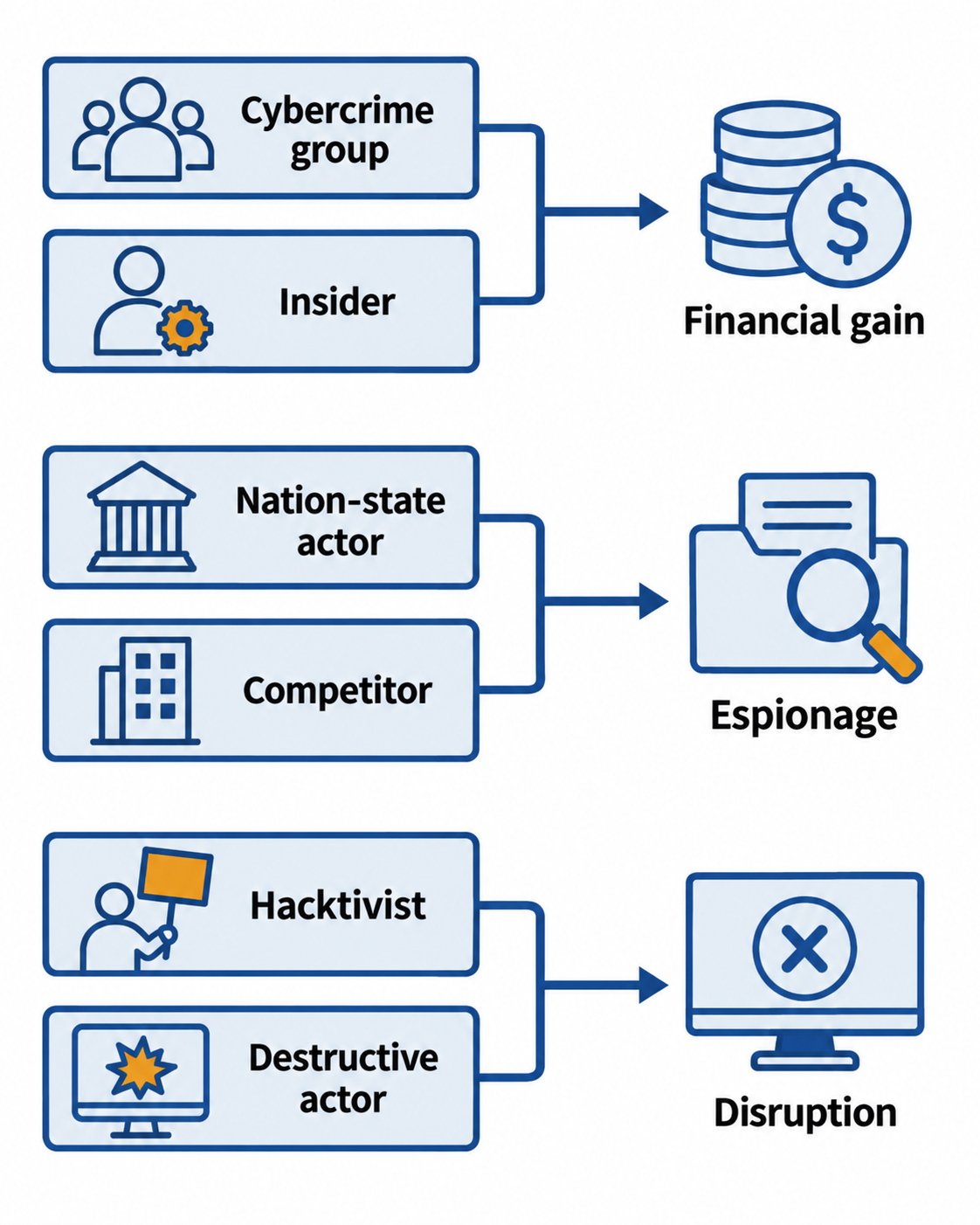
Figure 2.9: Illustrative links show how different actor categories can share objectives. An observed objective can support several actor hypotheses.
Text description for Figure 2.9
The examples connect cybercrime groups and insiders to financial gain, nation-state actors and competitors to espionage, and hacktivists and destructive actors to disruption. These links illustrate overlap and do not exhaust possible motives. An actor can pursue several objectives, and the same observed outcome may fit more than one actor category. Motivation alone cannot establish attribution, meaning identification of the actor responsible.
Actor Attributes: Internal vs. External Positioning
External threat actors operate outside your organization's network and must establish initial access through external attack surfaces. Examples include phishing, exploiting Internet-facing applications, or compromising third-party services.
Internal threat actors already possess legitimate network access through employment or contractor relationships. Internal actors can move laterally through the network and access sensitive systems without establishing external entry points. This positioning makes internal threats particularly dangerous.
Figure 2.10 compares starting positions while retaining the permissions that protect internal resources.
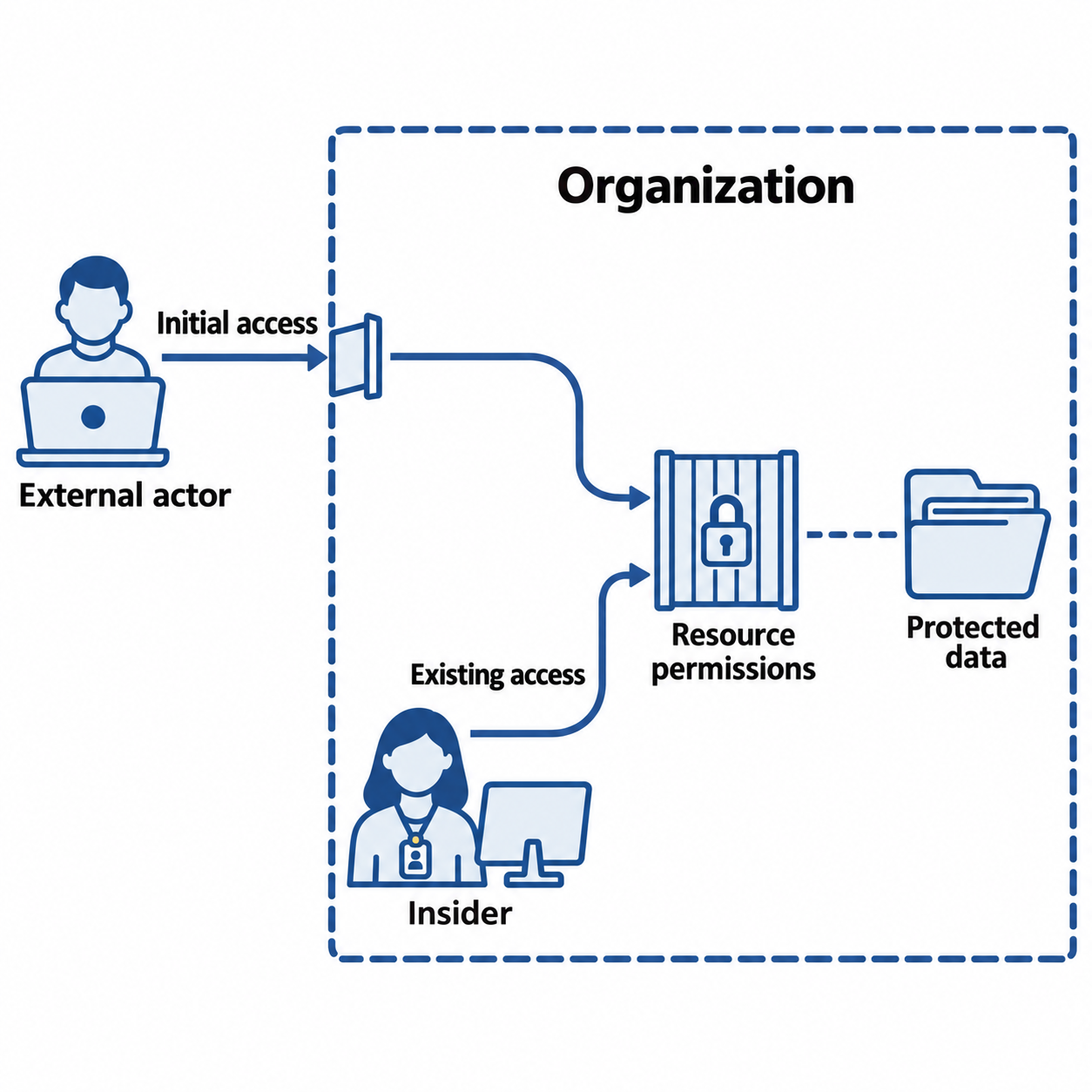
Figure 2.10: External actors must obtain an entry path. Insiders begin with existing access, while resource permissions still limit what either actor can reach.
Text description for Figure 2.10
An external actor may seek initial access through a public application, phishing, or a compromised third party. An insider begins with access granted through a role or relationship. Both can encounter further permissions protecting sensitive resources. Existing access does not imply administrator privileges or unrestricted movement. Investigators examine the actor's starting position and the controls along the path to the affected data.
Actor Attributes: Resources and Sophistication
Threat actors vary in their available resources and technical sophistication:
| Attribute | Low Sophistication | Moderate | High |
|---|---|---|---|
| Funding | Minimal; bootstrapped | Organized crime backend; modest state support | Well-funded state apparatus |
| Expertise | Script kiddie; limited coding | Mid-level developers; security knowledge | Cryptographers, 0-day researchers, reverse engineers |
| Tooling | Public exploits; off-the-shelf malware | Modified public tools; custom malware | Custom zero-days; proprietary malware families |
| Infrastructure | Compromised third-party servers | Rented VPS; bulletproof hosting | Distributed botnet; government infrastructure |
| Persistence | One-off attacks | Months of access | Years; strategic patience |
| Target Selectivity | Mass scanning and spray-and-pray | Targeted within industry | Highly selective based on strategic value |
High-sophistication actors are typically nation-states or mature criminal enterprises. They invest in development, research, and operational planning. Low-sophistication actors rely on volume and automation.
Putting It Together: Profiling a Threat Actor
Your organization detects a breach. The security team collects indicators:
- Initial access: Spear-phishing email with custom malware attachment, suggesting reconnaissance before attack.
- Malware characteristics: Custom backdoor, signed with a valid certificate, compiled recently.
- Command and control: Hardened infrastructure; attackers rotate domains and IP addresses.
- Data exfiltration: Over 2 weeks, attackers systematically downloaded intellectual property: source code, design documents, research results.
- No encryption or ransom demand, suggesting financial motivation is not primary.
- No destruction or disruptive activity; attackers operated stealthily.
- Targeting: The company is a defense contractor with government contracts.
Assessment: This attack bears hallmarks of nation-state espionage or state-sponsored IP theft. Indicators include custom malware, operational security discipline, patience during data collection, and strategic targeting. The attacker is a high-sophistication external actor with significant resources and likely state backing.
Response implications: This breach requires escalation to executive leadership, legal counsel, and potentially government agencies. The attacker likely has zero-day or advanced techniques; standard patching may be insufficient. Focus shifts to detecting persistence and exfiltration, not just initial compromise.
Figure 2.11 separates observed behavior from hypotheses about the responsible actor.
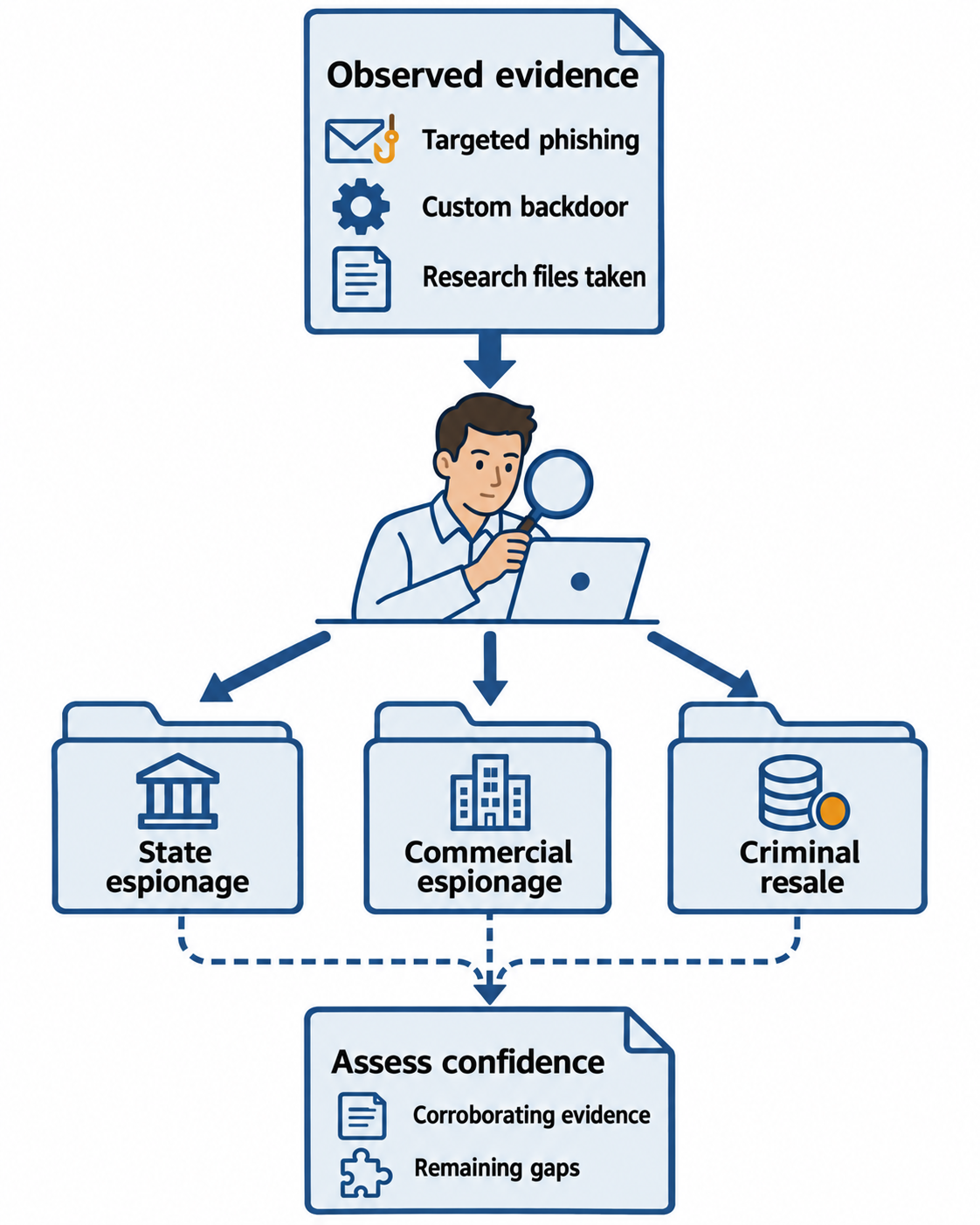
Figure 2.11: The breach observations support competing hypotheses. Analysts record corroborating evidence, confidence, and remaining gaps before attributing an attack.
Text description for Figure 2.11
The chapter scenario reports targeted phishing, a custom backdoor, and theft of research material. Those observations support investigating espionage, but they also allow alternatives such as commercial spying or criminal resale. Analysts compare hypotheses against corroborating evidence and document their confidence and gaps. Custom tools, a valid certificate, or an absence of a ransom demand do not independently establish state sponsorship or zero-day exploitation.
Chapter Summary
-
Threats, vulnerabilities, and risks are distinct concepts. A threat becomes a risk when it can exploit a vulnerability in your environment. Threat intelligence informs defensive decisions by answering who, what, how, and why.
-
Threat intelligence sources include OSINT (public information), commercial feeds, ISACs (sector peers), government agencies, and IoC feeds. Each source has strengths and limitations; mature programs combine multiple sources.
-
CVSS is the industry standard for vulnerability scoring. Base metrics reflect inherent severity; temporal metrics account for exploit availability and patch status; environmental metrics adjust for organizational context. Scores range from 0.0 to 10.0 and are grouped into five severity levels.
-
CVE and NVD provide standardized vulnerability identification and scoring. Understanding CVSS and CVE allows you to communicate vulnerability severity to business stakeholders and prioritize remediation.
-
Threat actors range widely in sophistication, resources, and motivation. Nation-states and APTs pursue strategic goals with advanced techniques. Organized crime groups seek financial gain. Hacktivists promote ideology. Insiders exploit trusted access. Unskilled attackers use automation and mass tactics.
-
Actor attributes including resources, sophistication, internal/external positioning, and motivation predict attack methods and targets. Matching observable attack characteristics to threat actor profiles informs incident response, threat hunting, and defensive strategy.
-
Vulnerability prioritization balances urgency, impact, and resource constraints. Actively exploited critical vulnerabilities demand immediate action; less severe vulnerabilities follow standard maintenance cycles.